
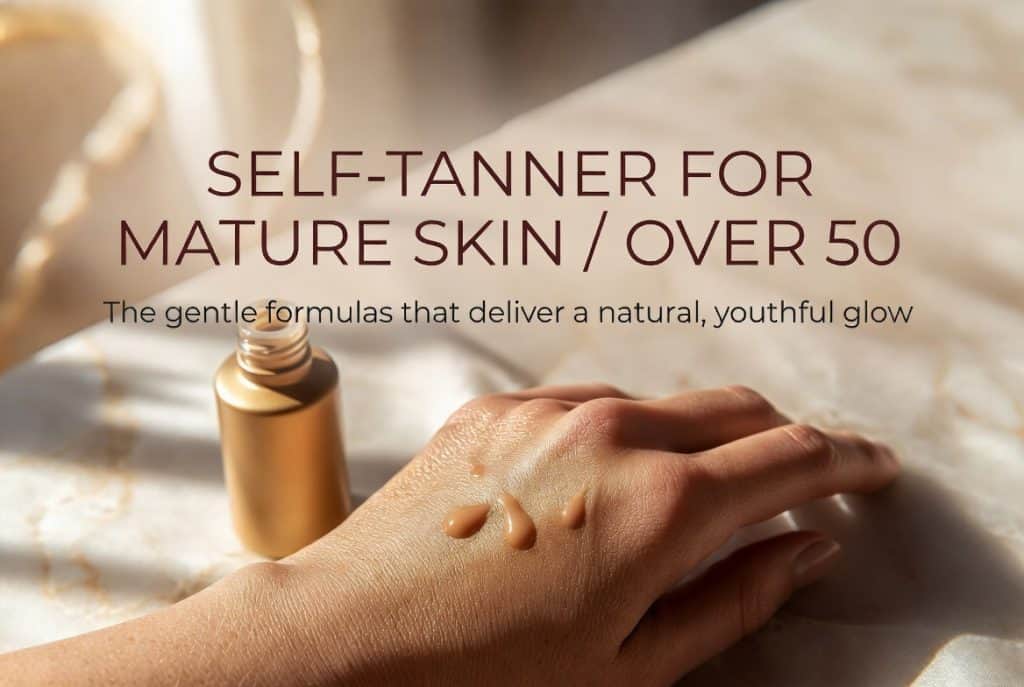
Best Self-Tanner for Mature Skin: Top Picks for Over 50
The best self-tanners for mature skin are hydrating, gradual, and buildable — formulas that add colour slowly and moisturise as they go, so they don’t cling to dry patches or settle into fine lines. For most people over 50, Vita Liberata Fabulous Gradual Tanning Lotion is the standout for its ultra-hydrating, buildable formula, while St. Tropez Classic Bronzing Mousse is the most forgiving option for a full, even tan and Isle of Paradise Self-Tanning Drops give you the most control by mixing into your own moisturiser.
Here’s the thing nobody tells you: self-tanner doesn’t behave the same way on mature skin as it did in your twenties. It can grab onto texture, pool in creases, and make age spots look darker. But that’s not a reason to skip it — it’s a reason to choose the right formula and adjust your technique. Done well, a sunless glow is one of the most flattering things you can do for skin at any age, with zero UV damage.
Below: why mature skin reacts differently, what to look for, the best formulas for over-50 skin, and exactly how to apply them for a smooth, natural result.
Key Takeaways
- Mature skin is drier and more textured, so it absorbs the tanning active (DHA) unevenly — dry and creased areas grab more colour. Hydration is the fix.
- Gradual and buildable formulas win. They add colour slowly, so mistakes are easy to correct before they set.
- Vita Liberata is the best hydrating pick, St. Tropez Classic Mousse is the most forgiving for a full tan, Isle of Paradise Drops give the most control, and Jergens Natural Glow +Firming is the best budget daily option.
- Prep matters more than the product. Exfoliate 24 hours before (not right before), and moisturise well in the days leading up to application.
- Look for hydrating, skin-loving ingredients like hyaluronic acid, glycerin, aloe, shea butter, and coconut — and go easy on knees, elbows, hands, and the neck.
- Sunless tanning is the smart choice as you age: the glow with none of the UV exposure that drives photoaging and skin-cancer risk.
Why Self-Tanner Behaves Differently on Mature Skin
Understanding what’s happening in your skin is the key to a good result. As skin ages, lipid production slows and cell renewal takes longer, leaving the surface drier, thinner, and paler than it once was (Hashizume, J Dermatol, 2004). None of that stops you from getting a beautiful tan — it just changes how the product behaves.
Self-tanner works because its active ingredient, DHA (dihydroxyacetone), reacts with the amino acids in the outermost layer of skin to create a temporary, surface-level colour (Braunberger et al., J Drugs Dermatol, 2018). That reaction is stronger wherever the skin is drier or thicker — which is exactly why mature skin can develop patchily. Dry knees, elbows, and hands grab extra colour, and product can settle into fine lines and pool in creases, emphasising the very texture you were trying to soften.
The solution is simple and consistent: hydrate thoroughly before and after, choose formulas that are fluid enough to spread evenly, and apply in thin, well-blended layers. Get those right and mature skin takes self-tanner beautifully.
What to Look for in a Self-Tanner for Mature Skin
Not every formula suits older skin. Here’s what actually makes the difference:
- Hydrating ingredients. Hyaluronic acid, glycerin, aloe, shea butter, squalane, and coconut keep skin plump so colour goes down smoothly instead of catching on dry spots.
- Gradual, buildable colour. Formulas you can layer over a few days are far more forgiving than an instant deep tan you can’t undo.
- A natural, neutral undertone. Mature skin can look a little sallow, so warm-but-natural tones flatter more than heavy bronze. Colour-correcting formulas help counter dullness.
- A gentle, low-fragrance formula. Skin gets more reactive with age, so nourishing formulas beat drying, heavily scented ones.
- A forgiving format. Gradual lotions and drops mixed into moisturiser tend to sit better on mature skin than fast-drying sprays or gels that grip on contact.
Best Self-Tanners for Mature Skin
These picks are grouped by what they do best, so you can go straight to the one that fits your skin and routine. (Shades and availability vary, so check the current listing.)
Best Overall for Hydration: Vita Liberata Fabulous Gradual Tanning Lotion
Vita Liberata Fabulous Gradual Tanning Lotion is a mature-skin favourite for good reason. It applies like a rich body moisturiser, is formulated with hyaluronic acid for serious hydration, and builds a natural glow gradually over daily use. The low-odour formula is gentle enough for dry and sensitive skin, and it fades evenly rather than patchily.
Pros: Deeply hydrating, buildable, gentle, minimal self-tan smell. Cons: It’s untinted, so there’s no guide colour to show where you’ve applied — take care to blend evenly. The gradual build also rewards patience.
Best for a Full, Forgiving Tan: St. Tropez Classic Bronzing Mousse
When you want a proper all-over tan for an event, St. Tropez Classic Bronzing Mousse is the benchmark. The tinted formula has a guide colour so you can see exactly where you’ve applied, develops over 4–8 hours into a natural olive-toned tan (no orange), and is infused with hydrating jojoba. Applied with a mitt, the mousse format is one of the most forgiving — it doesn’t streak the way liquids can.
Pros: Forgiving, guide colour aids application, natural undertone, long wear. Cons: A mousse takes a little more effort than a daily lotion, and you’ll want a mitt for the smoothest finish.
Best for Control: Isle of Paradise Self-Tanning Drops
Isle of Paradise Self-Tanning Drops let you mix a few drops into a moisturiser you already know works on your skin — which removes a big variable for mature skin that can be picky about new formulas. The colour-correcting undertones (green, peach, and violet across the shades) are especially useful for countering the sallowness that can creep in with age, and you control the depth drop by drop.
Pros: Total control over depth and base, colour-correcting, works face and body. Cons: You need to mix thoroughly and apply evenly, or the result can develop unevenly.
Best for the Face: Tan-Luxe The Face
The face is where texture and fine lines show most, so it deserves a dedicated formula. Tan-Luxe The Face is a lightweight, non-comedogenic drop formula with hyaluronic acid and raspberry seed oil that hydrates while it tans and won’t disrupt your skincare. Add two drops to your moisturiser for a whisper of colour or four to five for a proper glow. For more on facial application, see our guide to how to self-tan your face.
Pros: Gentle, hydrating, customisable, made for delicate facial skin. Cons: Premium price, and face-specific rather than a full-body solution.
Best Clean and Gentle: Beauty by Earth Self Tanner
Beauty by Earth Self Tanner is a clean, plant-based lotion built around organic aloe, shea butter, and coconut, with no dyes — which makes it a reassuring choice for reactive or sensitive mature skin. It works on face and body, goes on smoothly, and has a big base of loyal reviewers (including plenty over 60 and 70) who praise how natural and non-orange it looks.
Pros: Clean nourishing formula, gentle, face-and-body versatile, generous money-back guarantee. Cons: Some notice a mild developing scent, and there’s no guide colour, so blend carefully.
Best Budget Daily Option: Jergens Natural Glow +Firming
If you’d rather build colour with almost no effort, Jergens Natural Glow +Firming Moisturiser is a drugstore classic. You use it in place of your regular body lotion, and subtle colour develops over about a week. This version adds collagen and elastin for a light firming benefit, plus hydrating antioxidants — a nice touch for mature skin on a budget.
Pros: Very affordable, foolproof gradual build, hydrating and lightly firming. Cons: Colour is subtle and slow, so it’s not for a quick, deep tan; it’s body-focused.
How to Apply Self-Tanner on Mature Skin
With mature skin, prep does most of the work. Follow these steps and the application almost takes care of itself.
- Exfoliate 24 hours before — not right before. Freshly exfoliated skin absorbs colour too fast and unevenly. Gently exfoliate the day before, focusing on knees, elbows, ankles, and hands.
- Moisturise in the days leading up. Well-hydrated skin takes colour far more evenly than dry skin. Keep skin moisturised the day before you tan.
- Buffer the dry, grabby zones. Just before applying, smooth a light layer of plain moisturiser over knees, elbows, ankles, wrists, and the backs of hands so they don’t soak up too much.
- Apply in thin, even layers. Use a mitt for lotions and mousses. Build gradually — you can always add more tomorrow.
- Blend over lines and creases. Around the neck, décolletage, and any deeper lines, keep the layer light and buff well so colour doesn’t settle into folds.
- Mind the neck and hands. These give age away fastest, so blend colour down onto the neck to match your face, and go light on the hands.
- Wash your hands and let it develop. Rinse palms immediately (or use a mitt), then give gradual formulas time — often overnight — to reach full colour.
To keep the colour even and long-lasting, moisturise daily afterward — the same habit that helps any self-tanner last longer. If you’d rather skip tools, here’s how to apply fake tan without a mitt.
Common Mistakes to Avoid
- Going too dark. Deep bronze can look harsh on mature skin and highlight texture. A soft, natural glow is far more flattering — and more believable.
- Skipping hydration. Dry patches grab colour and fade unevenly. This is the number-one cause of patchy results on older skin.
- Exfoliating right before applying. Do it the day before, not the same hour.
- Overloading creases and hands. Light, well-blended layers prevent that darker, lined look in folds and knuckles.
- Expecting it to erase age spots. Self-tanner is a surface colourant — spots can even look temporarily darker. If that bothers you, a little leg or body makeup over spots can help, and formulas made to blur imperfections are worth a look.
If a patch does go wrong, it’s usually fixable with the same gentle tricks that fix streaks and unevenness — light exfoliation, a damp cloth, and a little time.
Is Self-Tanner Safe for Mature Skin — and Is It Worth It?
Yes on both counts. DHA is the only ingredient approved by the US FDA specifically for topical sunless tanning, and review-level research supports its safety for external cosmetic use (Owji et al., Photodermatol Photoimmunol Photomed, 2023). For reactive skin, favour gentle, hydrating, dye-free formulas and patch test first.
The bigger point for anyone over 50: a sunless tan spares you UV exposure entirely. Much of the visible aging we associate with older skin — the deeper wrinkling, the spotty pigmentation — is photoaging driven by cumulative sun exposure (Hashizume, J Dermatol, 2004), and UV tanning also raises the risk of melanoma (Ting et al., Int J Dermatol, 2007). Self-tanner delivers the glow with none of that cost. Just remember it offers no sun protection, so keep wearing daily sunscreen.
Frequently Asked Questions
Does self-tanner make wrinkles look worse?
It can if you apply too much or skip hydration, because product settles into lines and develops more intensely there. Applied in thin, well-blended layers on well-moisturised skin, a natural glow actually makes skin look more even and luminous, not more lined.
What’s the best self-tanner format for skin over 50?
Gradual lotions and drops mixed into your own moisturiser are usually the most forgiving, because they hydrate as they build and let you correct as you go. Tinted mousses with a guide colour are great for a full, even tan when applied with a mitt.
Will self-tanner cover age spots?
No — it’s a surface colourant, and spots can even look slightly darker at first because pigmented areas absorb more colour. It evens overall tone beautifully, but for specific spots, a little body makeup on top works better.
How do I stop my neck and hands looking uneven?
Blend colour down from your face onto your neck and décolletage so there’s no line, and go light on the hands. Buffing the backs of the hands with a damp cloth right after applying helps prevent that tell-tale darkened look.
Is gradual tanner or a full self-tanner better for mature skin?
Gradual tanners are ideal for everyday, low-effort colour and are very forgiving. A full self-tanner (like a mousse) is better when you want deeper colour for an occasion. Many people over 50 keep both: a daily gradual lotion, plus a mousse for events.
Do I still need sunscreen if I use self-tanner?
Absolutely. A sunless tan gives no UV protection. Since protecting mature skin from further sun damage is the whole point, daily facial and body SPF remains essential.
The Bottom Line
Self-tanner isn’t something you leave behind at 50 — it’s one of the smartest beauty choices you can make, giving you a healthy, sun-kissed glow with zero UV damage. The trick is matching the formula to mature skin: reach for Vita Liberata for hydration, St. Tropez Classic Mousse for a forgiving full tan, Isle of Paradise Drops for control, and Jergens Natural Glow +Firming when you want easy, affordable daily colour.
Whichever you choose, the fundamentals stay the same: hydrate well, exfoliate the day before, build colour gradually, and blend carefully around lines, the neck, and hands. Do that and your skin will look warm, even, and rested — never orange or overdone. From here, it’s worth reading up on self-tanning at home and the different types of tanning so you can build the routine that suits your skin best.
Research Sources
Skin Aging & Dry Skin:
Hashizume, 2004, The Journal of Dermatology, “Skin Aging and Dry Skin” Explains how chronological aging slows lipid formation and leaves skin drier and paler, and distinguishes it from UV-driven photoaging.
DHA Mechanism & Overview:
Braunberger et al., 2018, Journal of Drugs in Dermatology, “Dihydroxyacetone: A Review” Reviews how DHA reacts with amino acids in the outer layer of skin to create a temporary surface tan.
DHA Safety in Sunless Tanning:
Owji et al., 2023, Photodermatology, Photoimmunology & Photomedicine, “Properties and safety of topical dihydroxyacetone in sunless tanning products: A review” A review of the properties and safety profile of topical DHA in sunless tanning products.
UV Tanning & Melanoma Risk:
Ting et al., 2007, International Journal of Dermatology, “Tanning bed exposure increases the risk of malignant melanoma” Found that tanning bed exposure raises the risk of malignant melanoma, reinforcing why sunless alternatives are the safer route to colour.