
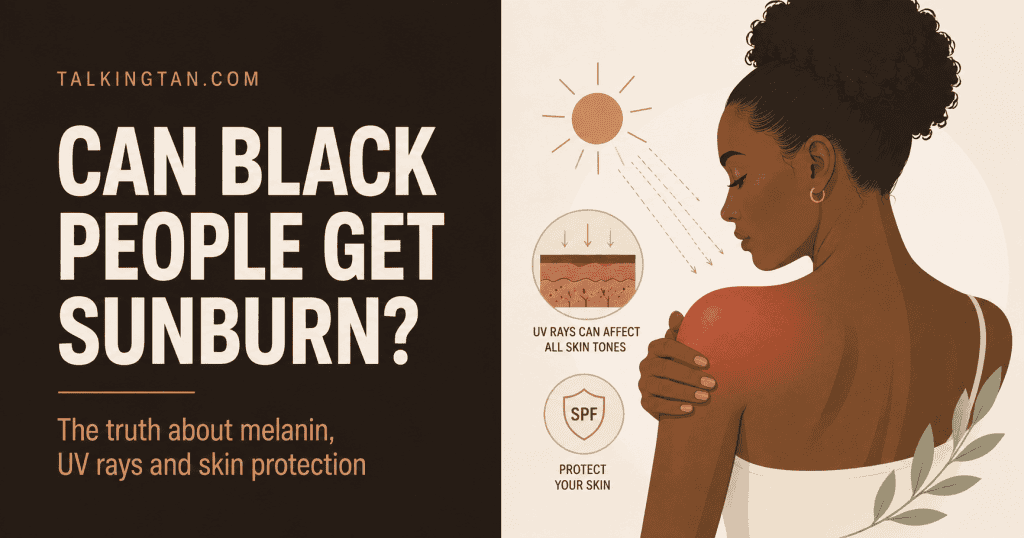
Yes. Black people can get sunburn. More melanin provides meaningful natural protection on average, so burning may be less common or take longer than it does in very fair skin, but it is not impossible. Black skin can become hot, tender, swollen, darker or grayish, peel, and blister after too much UV exposure.
The biggest mistake is relying only on visible redness. In deeper skin tones, sunburn can be harder to see, so pay attention to how the skin feels and to changes in tone, warmth, tenderness, swelling, or peeling. Everyone benefits from sensible sun protection.
Key Takeaways
- Black people can sunburn, even though melanin reduces UVB-related burning risk on average.
- Sunburn may look darker, purple, gray, or less visibly red in deeper skin tones.
- Warmth, tenderness, swelling, itch, peeling, or blisters can be more useful clues than redness alone.
- UV can also worsen hyperpigmentation and contribute to uneven tone and photoaging.
- Broad-spectrum sunscreen, shade, protective clothing, hats, and sunglasses are useful for all skin tones.
- Severe burns, blisters, fever, dehydration, confusion, or eye symptoms need medical advice.
Can Black people get sunburn?
Yes. Melanin filters some UV radiation and usually gives darker skin a higher natural level of protection against burning than lighter skin, but it does not block all UV. Skin tone is only one factor: UV index, altitude, reflection from water or sand, time outdoors, medication-related photosensitivity, and individual skin response all matter.
Clinical and experimental evidence shows that Black skin can warm, burn, peel, and develop sun-induced hyperpigmentation after sun exposure. [Fajuyigbe and Verschoore, Current Problems in Dermatology, 2021]
What does sunburn look like on Black skin?
It may not look bright red. Depending on your baseline tone and the area of skin, it may appear darker, deeper brown, purple, grayish, or unusually shiny. Sometimes the change is subtle, especially at first.
Pay close attention to symptoms you can feel:
- Skin that feels hot, sore, tender, tight, or itchy
- Swelling
- New darkness or uneven tone after time in the sun
- Peeling a few days later
- Blisters, wet-looking skin, or severe pain in a more serious burn
Check skin in good light
Look in natural daylight if possible and compare the area with nearby unexposed skin. On deeper tones, inflammation may show as a change in warmth, texture, sheen, or depth of color rather than obvious redness. Ask someone you trust to check hard-to-see areas such as shoulders, back, ears, and scalp if you have been outside for a long time.
Why sunscreen matters for Black skin
Sunscreen is not only about preventing visible redness. UV and visible light can worsen dark spots and uneven pigmentation, and UV protection also helps limit cumulative sun damage. Choose a sunscreen you will actually use consistently: broad-spectrum, SPF 30 or higher, and a texture that works for your skin. Tinted products may be worth considering if visible-light-related pigmentation is a concern, but the most important thing is regular, adequate use.
Expert recommendations note that darker skin may be more prone to pigmentation changes induced by UVA and visible light, while UV protection remains important across phototypes. [Passeron et al., Journal of the European Academy of Dermatology and Venereology, 2021]
How to use sunscreen without a white cast
There is no need to accept a chalky finish. Look for formulas marketed as sheer, invisible, clear, or tinted, and test them in daylight along the jawline or on the neck before committing. Lotions, gels, fluids, sticks, and tinted mineral formulas can all work; the right one is the formula you will apply generously and reapply.
Apply to all exposed skin, including ears, neck, hands, feet, hairline, scalp where hair is thinning, and lips with SPF lip balm. Reapply at least every two hours outdoors and after swimming, sweating, or towel drying.
Sun protection beyond sunscreen
Sunscreen is important, but it is not the only option—nor does it need to carry the whole job. Choose a wide-brimmed hat, UV-blocking sunglasses, a lightweight long-sleeved overshirt, and shade when the UV index is high. These choices are particularly useful when you are exercising, spending hours outdoors, swimming, or find reapplication difficult.
For scalp protection, a hat is often easier than trying to apply product through dense hair. For a visible part or thinning hairline, a non-greasy scalp sunscreen or stick may be more practical. Keep product out of the eyes and follow the label.
Can Black people get skin cancer?
Yes. Skin cancer is less common on average in people with darker skin, but it can still occur and may be recognized later when people assume they are not at risk. A new, changing, bleeding, non-healing, or unusual spot should be assessed by a dermatologist regardless of skin tone.
Do not use tanning or burning to address vitamin D concerns. If you are worried about vitamin D, discuss testing, food sources, or supplements with a healthcare professional rather than intentionally increasing UV exposure.
Sun protection for children and families
Children with Black skin need sun protection too. Their risk and visible signs can differ from an adult’s, but hot, tender, swollen, or peeling skin should still be taken seriously. Build shade, hats, protective clothing, and age-appropriate sunscreen into outdoor routines rather than waiting for a visible burn.
How to treat a sunburn on Black skin
- Get out of the sun and avoid more UV exposure while the skin heals.
- Cool the area with a cool shower, bath, or damp cloth—no direct ice.
- Drink fluids if you are alert and can keep them down.
- Use a simple fragrance-free moisturizer on intact skin if it is comfortable.
- Do not pick peeling skin or pop blisters.
- Get medical advice for large blisters, severe pain, infection signs, fever, nausea, dizziness, dehydration, or eye symptoms.
How to prevent sunburn and uneven tone
Use more than sunscreen. Seek shade around the middle of the day, wear sun-protective clothing, use a wide-brimmed hat and UV-blocking sunglasses, and check the local UV index. Reflected UV from water, sand, and snow can increase exposure even when you do not feel hot.
Our guide to tanning when it is cloudy explains why overcast weather is not a free pass. Check the UV index, understand what sunscreen actually does, and see sunblock options to prevent tanning for product-selection context.
Frequently Asked Questions
Do Black people need sunscreen every day?
Daily needs depend on how much time you spend outside, your local UV conditions, and your skin concerns, but sunscreen and other UV protection are useful for anyone with daytime exposure. It is especially important for long outdoor time, high UV index days, pigment concerns, and use of photosensitizing skincare or medication.
Why does my skin get darker after being in the sun?
UV exposure can stimulate pigmentation and may worsen existing dark marks. If the change is patchy, persistent, itchy, painful, or accompanied by a rash, ask a dermatologist for advice instead of assuming it is a normal tan.
Can Black people get heat rash instead of sunburn?
Yes, and the two can be confused. Heat rash often shows as small itchy bumps in hot, sweaty areas, while sunburn tends to cause heat, tenderness, swelling, and later peeling on exposed skin. A clinician can help if you are unsure.
Do Black people need a higher SPF?
SPF 30 or higher broad-spectrum sunscreen is a practical baseline for outdoor exposure across skin tones. Higher SPF can give a larger margin for under-application, but it does not replace using enough product, reapplying, and adding shade or clothing.
Final Thoughts
Black people can get sunburn, and sun protection is about more than avoiding visible redness. Notice how your skin feels, protect against UV and visible light, and seek care for severe or unusual symptoms. A routine that suits your skin tone and lifestyle is the one you are most likely to keep using.
References
Sun exposure and Black skin:
Fajuyigbe D, Verschoore M, 2021, Current Problems in Dermatology, “Sun Exposure and Black Skin”
Review discussing sun-induced effects including warming, burning, peeling, hyperpigmentation, and photoaging in Black skin.
Photoprotection across skin phototypes:
Passeron T et al., 2021, Journal of the European Academy of Dermatology and Venereology, “Photoprotection According to Skin Phototype and Dermatoses: Practical Recommendations from an Expert Panel”
Expert recommendations on UV, UVA, and visible-light protection across diverse skin phototypes.