
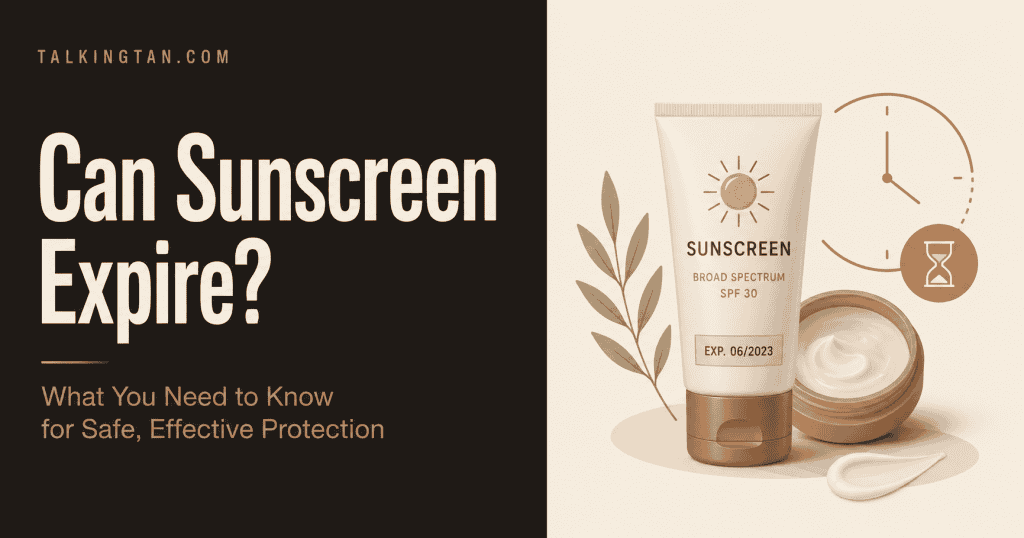
Yes, sunscreen expires. In the US, the FDA requires sunscreen to keep its labeled SPF for at least three years, so if there’s no expiration date printed on the bottle, treat it as expired three years after you bought it. If there is a date, go by that.
That’s the short version. The longer version is more useful, because the three-year rule assumes your sunscreen has been sitting somewhere cool and dark — and most people’s sunscreen has spent at least one summer baking in a car console or a beach bag. Heat and sunlight can wreck a bottle long before its printed date, and there’s no warning label for that.
Here’s how to tell whether your bottle is still doing its job, what actually happens when SPF degrades, and when you should stop debating and just buy a new one.
Key Takeaways
- Sunscreen expires. The FDA requires it to hold its labeled SPF for three years, so undated bottles should be tossed three years after purchase.
- Check the bottle first — many sunscreens do have a printed expiration or “period after opening” date.
- Unopened doesn’t mean immortal. The three-year clock runs whether or not you’ve broken the seal.
- Heat is the real villain. A bottle left in a hot car or in direct sun can degrade well before its date.
- Separated, watery, gritty, clumpy, discolored, or smelly sunscreen is done, regardless of what the label says.
- Expired sunscreen isn’t usually dangerous — it’s just unreliable, which is worse than it sounds when you’re relying on it.
- Mineral and chemical sunscreens both degrade, just in different ways.
- If you’re using enough sunscreen, you shouldn’t have leftovers to worry about. A full-body application is roughly a shot glass worth.
How Long Does Sunscreen Actually Last?
Three years is the number, and it comes from how the FDA regulates sunscreen. Sunscreen is classified as an over-the-counter drug, not a cosmetic, and OTC drugs need an expiration date unless the manufacturer can prove the product stays stable for at least three years. Brands that can prove it are allowed to skip the date entirely.
So a bottle with no expiration date isn’t a mistake or a shortcut — it’s a bottle the manufacturer tested to three years. Your job is just to remember when you bought it.
A few practical ways to handle that:
- Write the purchase month on the bottle with a permanent marker the day you bring it home.
- Check the bottom, the crimp at the end of a tube, or the shoulder of the bottle — dates are often stamped there rather than printed on the label.
- Look for a small open-jar icon with something like “12M” or “24M” inside. That’s the period-after-opening symbol, and it means the product is good for that many months once you’ve opened it.
Does unopened sunscreen last longer?
Not really. The three-year shelf life applies whether the seal is broken or not. An unopened bottle stored in a cool cupboard will hold up better than an opened one that’s been to the beach six times, but it doesn’t get bonus years. Sunscreen is a chemical suspension, and those ingredients slowly drift apart on their own schedule.
What Actually Happens When Sunscreen Expires
Sunscreen doesn’t flip from “working” to “not working” on a specific date. It fades. The UV filters break down, the emulsion that keeps everything evenly mixed starts to separate, and the SPF you’re actually getting drops somewhere below the number on the label — you just have no way of knowing how far below.
That uncertainty is the real problem. An SPF 50 that’s quietly become an SPF 20 doesn’t feel any different going on. You’ll apply it with the same confidence and stay out for the same amount of time, which is exactly how people end up burned while swearing they wore sunscreen.
Chemical sunscreens
Chemical filters absorb UV and convert it to heat, and some of them are genuinely fragile. Avobenzone, the most common UVA filter in the US, is the classic example: it breaks down when exposed to UV light, losing its ability to absorb UVA, though antioxidants and stabilizing ingredients can slow this down considerably [Afonso et al., Journal of Photochemistry and Photobiology B, 2014].
Modern formulas are built with stabilizers precisely because of this, and they hold up well within their shelf life. But an old, heat-abused bottle has had a lot of time for that chemistry to drift.
Mineral sunscreens
Zinc oxide and titanium dioxide are minerals. They don’t really “go bad” the way an organic filter does — they physically sit on skin and scatter UV. What fails in a mineral sunscreen is the formula around them. Once the emulsion separates, the mineral particles clump and settle, and you can no longer spread an even layer. Uneven layer, uneven protection.
This is why a separated mineral sunscreen isn’t rescuable by shaking it. You can remix the liquid, but you can’t restore the microscopic even dispersion the formula was designed around.
Heat Is What Really Kills Sunscreen
Here’s the part most articles skip. The three-year shelf life assumes reasonable storage. Most sunscreen doesn’t get reasonable storage — it lives in a beach bag in the sun, a hot car, or a poolside chair.
Temperature extremes visibly damage sunscreen. When researchers exposed a range of sunscreens and sunblocks to temperature extremes, several products showed clear phase separation, which the authors noted could translate into reduced sun protection because the active ingredients are no longer evenly distributed [Jung et al., Journal of the American Academy of Dermatology, 2012].
A closed car in summer can climb well past anything a sunscreen was formulated for. If your bottle has spent afternoons in a hot glove box, its printed expiration date is more of a suggestion than a guarantee.
Simple fixes that actually work:
- Keep sunscreen in the shade at the beach — wrap it in a towel or drop it in the cooler with the drinks.
- Don’t store the bottle in your car between trips.
- Keep the cap sealed tight so the formula doesn’t dry out or pick up bacteria.
- Store the main bottle somewhere cool and dark at home, and refill a small travel bottle for outings.
How to Tell If Your Sunscreen Has Gone Bad
Trust your senses before you trust the date. Any of these means it’s finished:
- Separation. A watery layer sitting on top, or oil that won’t remix after shaking.
- Texture change. Grainy, gritty, clumpy, or noticeably runnier and thinner than it was.
- Color change. Yellowing, browning, or darkening compared to when you bought it.
- Smell. A rancid, sour, or “off” smell often means bacterial contamination — which can also mean breakouts or irritation on top of poor protection.
- It stings or burns now and didn’t before. Degraded formulas can irritate skin. If your SPF has started to sting, that’s worth paying attention to — there are a few reasons sunscreen burns your face, and a broken-down formula is one of them.
A bottle can look perfect and still be past its date, so the sensory check is a fail condition, not a pass. Bad-looking sunscreen is definitely expired; good-looking sunscreen is just probably fine.
Is It Safe to Use Expired Sunscreen?
Expired sunscreen usually won’t hurt you. It just won’t reliably protect you, and that’s the risk — you behave as if you’re protected when you’re not.
The honest nuance: if you’re standing on a beach with nothing but a two-year-overdue bottle and no other option, using it is better than using nothing at all. Some degraded protection beats zero protection. But treat it as a bare minimum, not a plan — stay in the shade, cover up, reapply more often than you think you need to, and replace it as soon as you can.
What you shouldn’t do is rely on old sunscreen for a full day outdoors, or for a child’s skin. If the bottle smells off or has separated, skip it entirely — bacterial contamination can cause irritation and breakouts on top of the failed SPF.
Sunscreen Isn’t the Only Thing in Your Bag With a Clock On It
If you’re auditing your sunscreen, the rest of your tanning and skincare stash is probably due for the same treatment. Almost everything in there has a shelf life:
- Tanning lotions expire too, and separated ones apply just as unevenly as separated sunscreen.
- Self tanner has a shorter clock than you’d expect — the DHA in it degrades, which is why old bottles can develop weird, off-tone results.
- Even small stuff counts. Lip balm expires, and SPF lip balm has the same UV-filter problem as body sunscreen.
A quick once-a-year clear-out at the start of summer takes about ten minutes and saves you the guessing.
How to Not Have This Problem Next Year
The real answer to “is my sunscreen still good” is that you shouldn’t have year-old sunscreen in the first place. Most people dramatically underuse it. A full-body application is about an ounce — roughly a shot glass — and a face-and-neck application is around a nickel-sized amount. At that rate, a standard bottle doesn’t survive a summer of regular use.
So if you’re finding half-full bottles from two summers ago, the expiration date isn’t really the issue. Applying more generously fixes both problems at once: better protection now, and fresh product every season.
A few habits that help:
- Buy a size you’ll realistically finish in one season rather than a jumbo bottle that lingers for years.
- Date the bottle with a marker when you open it.
- Keep a dedicated bottle for the car or gym bag and accept that it’ll degrade faster — replace that one more often.
- Reapply every two hours outdoors, and immediately after swimming or towel drying.
And if your goal is protection rather than pale skin, it’s worth knowing that you can still tan while wearing sunscreen — no sunscreen blocks 100% of UV. If you actively want to avoid color, that calls for a different kind of product and a stricter reapplication schedule.
FAQ
How long is sunscreen good for after opening?
Usually the same three years from purchase, unless the bottle shows a period-after-opening symbol (a small open jar marked 12M, 24M, and so on). If it does, follow that number instead — it’s shorter for a reason.
Can expired sunscreen cause a rash or breakouts?
It can. Degraded formulas and bacterial contamination are both common causes of irritation, stinging, and clogged pores from old sunscreen. If the product smells off or looks separated, throw it out rather than testing it on your face.
Does sunscreen expire if it’s never been opened?
Yes. The three-year clock runs regardless of whether the seal is broken. Unopened sunscreen stored somewhere cool will be in better condition at year three than an opened bottle that’s been to the beach, but it doesn’t last longer than three years.
Is expired sunscreen better than no sunscreen?
In an emergency, yes — partial protection beats none. But you have no way of knowing how much SPF is left, so don’t treat it as a full day’s coverage. Seek shade, cover up, reapply frequently, and replace the bottle as soon as possible.
Does sunscreen go bad in a hot car?
Faster than it should. High heat can break the emulsion and degrade the UV filters well before the printed expiration date. If a bottle has lived in your car through a summer, replace it rather than trusting the label.
Can I use expired sunscreen in a tanning bed?
You shouldn’t be using expired product anywhere, and sunscreen in a tanning bed is its own separate question with some real caveats — here’s what to know before you try it.
What should I do with expired sunscreen?
Don’t pour it down the drain. Seal the container and put it in your household trash, or check whether your area has a pharmaceutical or hazardous waste drop-off, since sunscreen is regulated as an OTC drug.
The Bottom Line
Sunscreen expires, three years is the default assumption, and heat can shorten that considerably. Check the bottle for a date first, and if there isn’t one, go by when you bought it — then let your eyes and nose overrule the label if the formula looks or smells wrong.
The most practical takeaway isn’t really about expiration dates at all, though. If you’re applying a proper amount and reapplying every couple of hours, you’ll finish a bottle within a season and never have to think about this again. Store it in the shade, keep it out of the car, and replace it every summer.
If you’re building out a smarter sun routine from here, it’s worth reading up on where sunscreen fits in your product order and which clothing colors actually block the most UV — both make a bigger difference than most people expect.
References
Sunscreen stability and temperature:
Jung GW, Ting PT, Salopek TG, 2012, Journal of the American Academy of Dermatology, “Stability of sunscreens and sunblocks following exposure to extreme temperatures” Several sunscreen and sunblock products showed visible phase separation after exposure to temperature extremes, which the authors noted may reduce sun-protective efficacy by disrupting the even distribution of active ingredients.
UV filter breakdown:
Afonso S, Horita K, Sousa e Silva JP, et al., 2014, Journal of Photochemistry and Photobiology B: Biology, “Photodegradation of avobenzone: Stabilization effect of antioxidants” Avobenzone, a widely used UVA filter, degrades under UV exposure and loses absorption capacity; antioxidants such as vitamin E, vitamin C, and ubiquinone improved its photostability.