
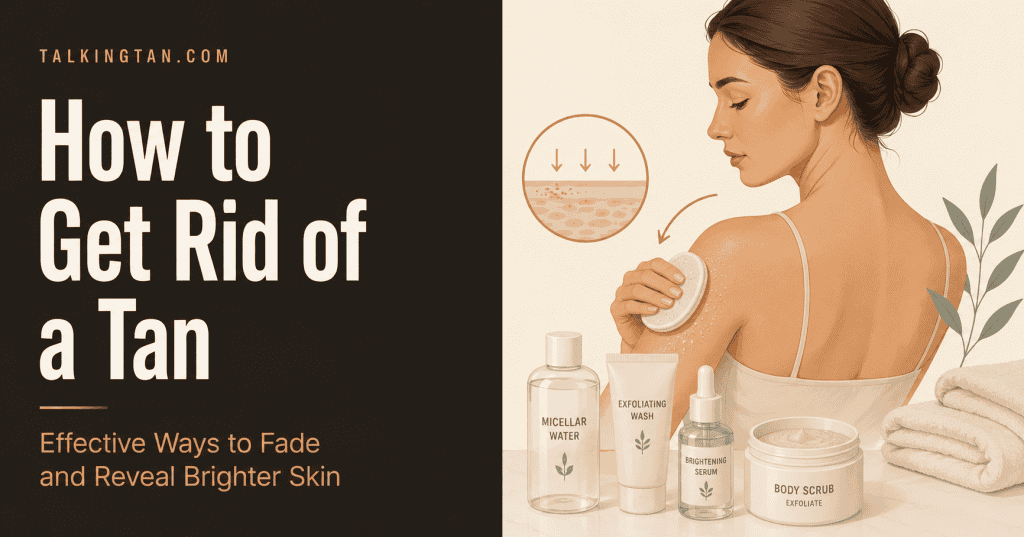
You can’t scrub, bleach, or wash a real tan off — it fades. A UV tan is pigment sitting inside living skin cells, so it only disappears as your skin naturally replaces those cells, which usually takes about two to four weeks. Everything you do to “remove” it is really just supporting or gently speeding up that process.
That’s the honest version, and it’s the part most articles skip before they hand you a lemon juice recipe. The good news: there is a real toolkit that makes a tan fade faster and more evenly, and it works without wrecking your skin barrier.
First: Which Kind of Tan Do You Actually Have?
This matters more than anything else, because the two types come off in completely different ways.
- A fake tan (self-tanner, spray tan, gradual tan lotion) is a stain on the outermost dead layer of skin. That one genuinely can be exfoliated and dissolved off, sometimes in a single session. If that’s you, head to our full guide on how to remove self tanner — the methods below aren’t the fastest route for you.
- A real tan from the sun or a tanning bed is melanin produced deep in the living layers of your skin. It cannot be lifted off. It has to grow out.
Not sure? A fake tan tends to look orange-toned, sits unevenly around knuckles and elbows, and rubs off on a wet washcloth. Everything from here on is about real tans.
Key Takeaways
- A real tan is melanin inside living skin cells — you can’t physically remove it.
- Most tans fade noticeably in 2–4 weeks as skin cells naturally turn over.
- Gentle, consistent exfoliation helps a little. Aggressive scrubbing helps zero and irritates a lot.
- Daily sunscreen is the single most effective step, because it stops you re-tanning while you’re trying to fade.
- Vitamin C, niacinamide, alpha arbutin and mild AHAs can nudge pigment down over weeks — not days.
- Moisturized, healthy skin sheds more evenly, so barrier care beats harsh treatments.
- Lemon juice, bleach, baking soda scrubs and hydrogen peroxide are unsafe and don’t work. Skip them entirely.
- Chemical peels and laser exist, but they’re aimed at sun damage and pigment disorders, not at rushing a normal tan.
Why You Can’t Scrub a Tan Off
When UV hits your skin, specialised cells called melanocytes ramp up production of melanin — your body’s built-in sunshade — and pass it into surrounding skin cells. __Melanin production is driven by tyrosine being converted through the melanogenesis pathway inside melanocytes__ [Smit et al., Journal of Investigative Dermatology, 1997]. That pigment then sits packaged inside living keratinocytes, several layers below the surface.
So when you attack your skin with a gritty scrub, you’re sanding off dead surface cells that hold almost none of the new pigment. The tan is underneath, in cells that haven’t reached the surface yet. More on this in our guide on whether exfoliating removes a tan, but the short answer is: it helps at the margins, it isn’t the mechanism.
The actual mechanism is turnover. Skin cells are produced at the base of the epidermis, migrate upward, and are shed. __Classic cell-kinetics work in normal human epidermis put the mean turnover time of the whole tissue at around 39 days__ [Weinstein et al., Journal of Investigative Dermatology, 1984]. Your tan leaves when those pigment-loaded cells reach the surface and flake away — invisibly, a few at a time.
How Long Does a Tan Last If You Do Nothing?
For most people, a sun tan is visibly lighter within 7–10 days and mostly gone in 2–4 weeks. A deep, heavily built-up tan from a two-week holiday can hang around closer to a month or more. Tans from indoor beds tend to behave similarly — we break the timelines down in how long a tan lasts from a tanning bed and in our general guide to how long a tan lasts.
Realistically, a good routine might shave a week off. It won’t take you from bronze to baseline over a weekend. For a fuller breakdown of the fade curve, see how long it takes for a tan to go away.
The Realistic Toolkit: What Genuinely Speeds Fading
1. Stop Adding UV (Non-Negotiable)
You cannot fade a tan while topping it up. Every sunny commute, every lunch outside, every bed session resets the clock. If you’re serious about fading, treat UV avoidance as step one — shade, sleeves, hats, and no tanning sessions at all. Our guide on how to prevent tanning covers the practical version of this.
2. Wear Sunscreen Every Single Day
This is the highest-leverage step on the list. A broad-spectrum SPF 30–50, applied properly and reapplied outdoors, stops new melanin being triggered so your existing tan fades without reinforcement. Uneven areas even out faster too. We compare options in the best sunblock to prevent tanning.
Worth saying plainly: this is also the health argument. __Indoor tanning is associated with a meaningfully increased risk of melanoma, with risk rising alongside use__ [Ting et al., International Journal of Dermatology, 2007], and __a large systematic review and meta-analysis found indoor tanning raises the risk of both melanoma and non-melanoma skin cancers, with a stronger effect on early-onset melanoma__ [An et al., Cancers, 2021].
3. Gentle, Consistent Exfoliation
Exfoliation doesn’t remove pigment, but it clears the dulling layer of dead cells on top and encourages even shedding, so a tan looks brighter and fades more uniformly.
- 2–3 times a week is plenty. Daily scrubbing is counterproductive.
- A soft washcloth, exfoliating mitt or a mild chemical exfoliant beats anything sharp and gritty.
- If skin feels tight, stings, or goes red, you’ve overdone it — back off for a few days.
Irritated skin can actually darken (post-inflammatory pigmentation), which is the exact opposite of what you’re going for.
4. Moisturize and Protect the Barrier
Dry skin sheds in patches and looks flat and darker than it really is. Well-hydrated skin sheds evenly and reflects light better, so the tan reads lighter within days. Moisturize twice daily — glycerin, hyaluronic acid, ceramides and squalane all work. Post-sun formulas are good here too, see the best after tanning lotions.
5. Brightening Ingredients (The Slow, Real Ones)
These work on pigment production and distribution rather than stripping skin. Expect gradual change over three to eight weeks of consistent use.
- Niacinamide — one of the best-studied options. __Topical niacinamide reduced cutaneous hyperpigmentation in clinical testing, and works partly by suppressing the transfer of pigment packages from melanocytes into surrounding skin cells__ [Hakozaki et al., British Journal of Dermatology, 2002]. Well tolerated at 4–5%.
- Vitamin C (L-ascorbic acid) — an antioxidant that also interferes with pigment formation. Best used in the morning under sunscreen.
- Alpha arbutin — a gentle, gradual pigment-inhibitor that suits sensitive skin.
- AHAs (glycolic, lactic, mandelic) — chemical exfoliants that loosen dead cells and help pigment clear more evenly. Start at low strength, 2–3 nights a week, always with daytime SPF.
To be clear about what these are and aren’t: they help a temporary tan return to your natural baseline faster. They’re not a route to skin lighter than your own, and they shouldn’t be used that way.
Tan Lines: A Special Problem
Tan lines are frustrating because you’re not fading one tone, you’re waiting for two tones to converge. The dark side fades on its normal schedule, and the pale side stays pale — so the line softens gradually rather than vanishing.
What actually helps:
- Fade both, don’t tan the pale bit. Sunning the untanned strip is the intuitive fix and the wrong one — more UV, and usually a burn on skin with no built-up protection.
- Exfoliate and moisturize the whole area evenly, not just the dark side.
- Use self-tanner as a bridge if you need to look even next week. Blend a gradual tanner onto the pale strip and feather the edges.
- Body makeup works for a single evening.
We’ve got a dedicated walkthrough on how to get rid of tan lines, plus timelines in how long tan lines last.
Why Your Face and Legs Fade at Different Speeds
Your face usually lightens first while your legs hold colour for weeks. That’s normal.
- Turnover varies by body site. Facial skin is thinner and renews faster; legs and back are thicker and slower.
- Your face gets more skincare. Cleansing, actives and moisturizer all help. Most people do nothing to their shins.
- Legs are drier. Fewer oil glands means more dead cell build-up, which makes a tan look darker than it is.
- Faces get more incidental sun, so they can be fading and re-tanning at the same time.
Related reading if this is a recurring frustration for you: why doesn’t my face tan and why won’t my legs tan.
Professional Options — and Honest Expectations
A dermatologist has stronger tools, but manage expectations: these treatments are designed for sun damage and pigment disorders, not for rushing a normal holiday tan.
- Chemical peels. A superficial glycolic or salicylic peel speeds up shedding of the upper layers, so a tan can look lighter sooner. Medium-depth peels do more but come with downtime.
- Laser and light treatments. Effective for sun spots, but most lasers are risky on freshly tanned skin — reputable clinics make you wait several weeks after sun exposure, which rather defeats the purpose here.
- Prescription topicals. A medical conversation for stubborn pigment issues, not a tan-fading shortcut.
For an ordinary tan? Time plus sunscreen plus moisturizer gets you nearly the same place for free.
What Not to Do: The Myths That Can Actually Hurt You
These circulate constantly, and every one is a bad idea.
- Lemon juice. Citrus on skin plus sunlight causes phytophotodermatitis — a burn-like reaction that leaves dark patches lasting months. The worst item here, because it causes exactly the pigmentation you wanted gone.
- Household bleach. Never. It causes chemical burns and does nothing to melanin inside living cells.
- Hydrogen peroxide. Blanches and damages the skin surface. It doesn’t lighten a tan; it wrecks the barrier and can leave you more pigmented.
- Baking soda scrubs. Highly alkaline and abrasive — bad for your skin’s pH and barrier, and the grit just irritates.
- Aggressive scrubbing, loofahs and long hot showers. All strip the barrier without touching the pigment.
- Toothpaste, vinegar and other kitchen “hacks”. Irritation dressed up as a remedy.
The pattern is worth naming: every one of these works by damaging skin, and damaged skin responds by producing more pigment, not less.
A Simple Four-Week Routine
- Mornings: gentle cleanse, vitamin C or niacinamide serum, moisturizer, SPF 30+ on every exposed area including neck, ears and hands.
- Evenings: cleanse and moisturize head to toe. Add an AHA or niacinamide 2–3 nights a week if your skin tolerates it.
- 2–3 times a week: gentle exfoliation in the shower, then moisturizer straight onto damp skin.
- All month: minimise UV — shade, clothing, no tanning sessions.
- Weekly: take a photo in the same light. Fading is slow enough that you’ll swear nothing’s happening; the photos will disagree.
Frequently Asked Questions
How can I get rid of a tan overnight?
You can’t, if it’s a real UV tan. Overnight results are only possible with a fake tan, which can be exfoliated and dissolved off. For a real tan, the fastest genuine route is moisturizing well and exfoliating gently — which improves how it looks, not how much pigment is there.
Does exfoliating remove a tan?
Not directly. It removes dead surface cells and makes skin look brighter and more even, and it supports natural turnover. But the pigment lives in cells deeper down that exfoliation can’t reach.
Is lemon juice safe for lightening a tan?
No. Citrus on skin combined with sunlight can cause a burn-like reaction and long-lasting dark patches. Don’t do it.
Does drinking water help fade a tan?
Staying hydrated supports overall skin health, and hydrated skin looks brighter. But drinking water doesn’t dissolve melanin or measurably speed up fading.
Will a tan ever go away completely?
An ordinary tan, yes — your skin returns to baseline within a few weeks. What doesn’t fully reverse is the accumulated sun damage: freckles, sun spots and uneven pigment that build up over years. Those are a separate issue and worth a dermatologist’s opinion.
Does a tanning bed tan fade faster than a sun tan?
Roughly the same, sometimes slightly faster because bed tans are often less deeply built up. It’s the same biological process either way.
The Bottom Line
Getting rid of a tan isn’t a removal job, it’s a fade. Melanin sits inside living skin and leaves on your skin’s schedule — typically two to four weeks. What you control is whether that fade is fast and even or slow and patchy.
The winning combination is unglamorous: daily broad-spectrum sunscreen so you stop re-tanning, generous moisturizer so skin sheds evenly, gentle exfoliation two or three times a week, and a brightening serum like niacinamide or vitamin C to nudge things along. Skip the kitchen chemistry — it damages skin and often makes pigmentation worse.
And if you’re on a deadline, the practical answer isn’t a faster fade. It’s evening things out with a good self-tanner while nature does the rest.
References
Melanin formation:
Smit NP et al., 1997, Journal of Investigative Dermatology, “Melanogenesis in cultured melanocytes can be substantially influenced by L-tyrosine and L-cysteine” Demonstrates that melanin production in melanocytes depends on the amino acid tyrosine, the starting point of the melanogenesis pathway that creates tan pigment.
Skin cell turnover:
Weinstein GD, McCullough JL, Ross P, 1984, Journal of Investigative Dermatology, “Cell proliferation in normal epidermis” Measured cell proliferation and transit kinetics in normal human epidermis, reporting a mean epidermal turnover time of approximately 39 days.
Niacinamide and pigmentation:
Hakozaki T et al., 2002, British Journal of Dermatology, “The effect of niacinamide on reducing cutaneous pigmentation and suppression of melanosome transfer” Found that topical niacinamide reduced hyperpigmentation in clinical testing and inhibited the transfer of melanosomes from melanocytes to keratinocytes.
UV exposure and skin cancer risk:
Ting W et al., 2007, International Journal of Dermatology, “Tanning bed exposure increases the risk of malignant melanoma” Reports an increased risk of malignant melanoma associated with tanning bed exposure.
Indoor tanning meta-analysis:
An S et al., 2021, Cancers, “Indoor Tanning and the Risk of Overall and Early-Onset Melanoma and Non-Melanoma Skin Cancer: Systematic Review and Meta-Analysis” Pooled analysis finding indoor tanning is associated with increased risk of melanoma and non-melanoma skin cancer, with a stronger association for early-onset melanoma.