
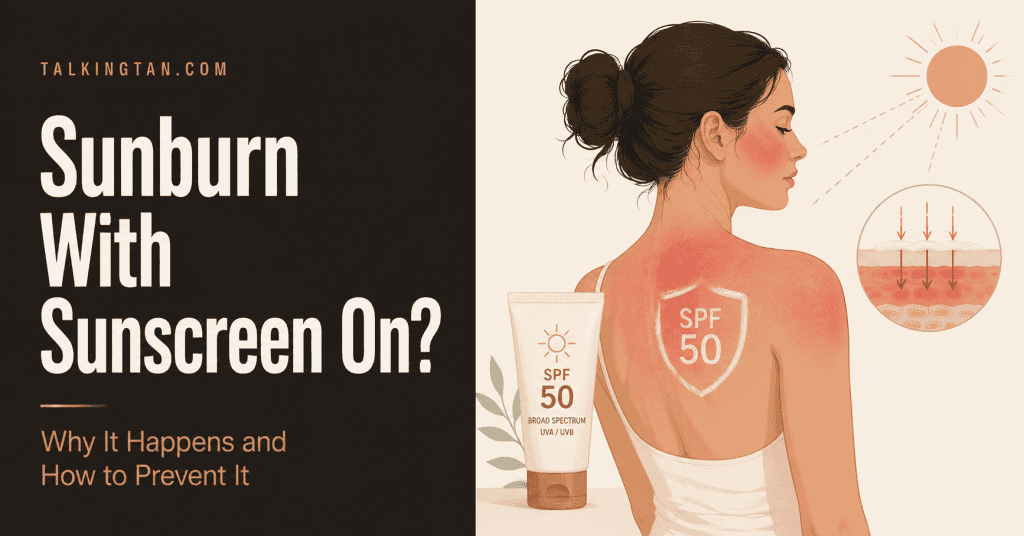
You can get sunburn with sunscreen on because SPF only works as well as the amount you apply, the coverage you achieve, and how long it stays on your skin. Using too little, missing spots, failing to reapply, swimming or sweating, or spending a long time in intense UV can all leave enough UV exposure to cause a burn.
The important point is that sunscreen did not necessarily “stop working.” More often, the real-world protection was lower than the number on the bottle, or the total UV dose was greater than the protection could handle. Here is why that happens and how to prevent it next time.
Key Takeaways
- SPF is a measure of UVB sunburn protection under laboratory conditions; it is not a timer that lets you stay in the sun a set number of times longer.
- The SPF on the bottle is tested at a generous application thickness. Most people use less, which lowers the protection they get.
- Missed areas—such as ears, hairline, eyelids, neck, tops of feet, and back—can burn even when the rest of your skin is protected.
- Water-resistant does not mean waterproof or sweatproof. Reapply after swimming, sweating, and towel drying, and at least every two hours outdoors.
- Apply sunscreen before you go into the sun, not once you already feel warm or exposed.
- High UV conditions, reflection from water or sand, and long outdoor days raise the chance of burning through imperfect coverage.
- Broad-spectrum, water-resistant SPF 30+ is a useful baseline, but shade and clothing are still part of the plan.
- See a clinician for a severe burn, widespread blisters, fever, chills, nausea, dizziness, or signs of dehydration.
Why did I get sunburn with sunscreen on?
The short answer: sunscreen is not an invincibility shield. It filters UV, but it does not block every ray, and its labeled SPF is based on a carefully measured, even layer of product. In everyday life, people often apply less than the test amount, rub some off, miss skin, or stay exposed for longer than planned.
SPF is determined using sunscreen applied at 2 mg/cm², and sunburn protection changes when the applied thickness is lower. [Liu et al., Photodermatology, Photoimmunology & Photomedicine, 2012]
So, a burn while wearing SPF does not automatically mean your sunscreen was defective. It is a prompt to look at the full picture: product choice, application, reapplication, local UV conditions, and other protection.
9 reasons you can burn while wearing sunscreen
1. You did not apply enough
This is the most common reason. The SPF rating is measured at a much thicker, more even layer than most people use. For exposed adult skin from head to toe, a useful rough guide is about one ounce—roughly a shot-glass amount. For the face and neck, use enough to cover both areas evenly rather than relying on a few small dots.
A real-world study found that the median sunscreen application density on the face was 1.33 mg/cm², below the 2 mg/cm² standard used in SPF testing, and measured protection fell as application density decreased. [Fujiwara et al., Photodermatology, Photoimmunology & Photomedicine, 2022]
2. You missed part of your skin
It is easy to protect the center of the face, shoulders, and chest while overlooking the ears, eyelids, hairline, sides of the neck, lips, hands, tops of the feet, and back. A sunscreen burn often appears in exactly these gaps.
UV imaging studies have found that people disproportionately miss parts of the eyelid and eye area during routine sunscreen application. [Pratt et al., PLOS ONE, 2017]
Slow down around the face and ask someone to help with hard-to-reach areas. A hat, sunglasses, and clothing can cover the spots that are hardest to apply correctly.
3. You did not reapply often enough
A morning application is not designed to carry you through an entire beach day, hike, sports session, or outdoor event. Reapply at least every two hours while outdoors, and sooner when the product label tells you to. If you used a spray, make sure the skin is visibly and evenly coated, then rub it in as directed.
Reapplication is not because the number on the bottle has a countdown timer. It is because coverage becomes uneven over time through normal movement, touching your face, clothing friction, and outdoor activity.
4. Swimming, sweat, or towel drying removed some coverage
“Water resistant” means a product has been tested to retain protection for a stated period of water exposure—usually 40 or 80 minutes. It does not mean the product is waterproof or sweatproof. Swimming, heavy sweating, and towel drying can all remove sunscreen from the areas that need it most.
Reapply immediately after getting out of the water or drying off, even if you applied sunscreen shortly before.
5. You applied it after the UV exposure had already started
Applying sunscreen only after you arrive at the beach, start a walk, or begin to feel warm creates an unprotected window. Apply it before sun exposure, following the timing on the product label. If you will be outdoors for a while, bring the bottle with you rather than assuming the first application will be enough.
6. You treated SPF as a time multiplier
SPF 30 does not mean you can stay in the sun 30 times longer without burning. SPF measures relative UVB sunburn protection under a standardized test; real burn time varies with how much you applied, your skin’s sensitivity, the UV index, sweat, water, reflection, and how long you remain outdoors.
For a clearer breakdown of what SPF does and does not do, see can you tan with sunscreen?.
7. The UV conditions were stronger than you realized
UV can be intense even when the air feels cool or when clouds make the day look less sunny. Water, sand, and snow can also reflect UV onto skin. The longer you are outdoors and the stronger the UV conditions, the less room there is for application mistakes.
Check the forecasted UV index before a long outdoor day and adjust your plan. Our guide to the UV index and tanning explains what the number means for exposure, while this cloudy-day guide covers why overcast conditions can still lead to a burn.
8. You relied on makeup or moisturizer with SPF for a long outdoor day
Makeup and moisturizer with SPF can be useful for routine, incidental exposure. But they are often applied in a thinner layer than a dedicated sunscreen, and people rarely reapply them like sunscreen during a day outside. For prolonged or high-UV exposure, use a broad-spectrum, water-resistant sunscreen as your main protection, then apply makeup on top if you want to.
9. Sunscreen was your only line of defense
Sunscreen works best as one layer in a wider plan. Seek shade when you can, wear sun-protective clothing, use a broad-brimmed hat and UV-protective sunglasses, and take breaks from direct exposure. If your goal is avoiding extra color as well as preventing a burn, our guide to sunblock options to prevent tanning can help with product selection.
Does broad-spectrum sunscreen prevent sunburn?
Broad-spectrum sunscreen protects against both UVA and UVB radiation. Because SPF primarily measures UVB protection—the part of UV most associated with sunburn—the SPF number still matters when your main concern is burning. Choose a product labeled broad spectrum and SPF 30 or higher, then use it generously and repeatedly according to the label.
No sunscreen blocks 100% of UV. A higher SPF can offer a larger safety margin, particularly because people tend to underapply, but it still needs correct coverage and reapplication. Do not use a high SPF as a reason to stay in direct sun longer.
How to stop burning through sunscreen next time
- Choose the right baseline. Pick a broad-spectrum, water-resistant SPF 30 or higher for outdoor time.
- Apply before exposure. Follow the product instructions, and apply enough to create an even layer over all exposed skin.
- Use a coverage routine. Face, ears, neck, scalp or hairline, arms, hands, legs, feet, and back. Use SPF lip balm for lips.
- Reapply deliberately. Reapply at least every two hours outdoors and after swimming, sweating, or towel drying.
- Plan around conditions. Check the UV index, find shade, and wear protective clothing when conditions are strong or you will be outside for a long time.
- Replace old products. Follow the expiration date and storage instructions on the bottle. Do not rely on sunscreen that has been left in excessive heat or direct sun for long periods.
What if you already burned while wearing sunscreen?
Get out of the sun and avoid further UV exposure while the skin heals. Cool the area gently with a cool shower or damp cloth, drink fluids if you can, and avoid popping any blisters. Treat the burn seriously even if it happened while wearing SPF.
Get medical advice promptly for severe pain, widespread blisters, fever, chills, nausea, dizziness, dehydration, signs of infection, or a burn in a baby or young child.
Frequently Asked Questions
Can you get sunburn with SPF 50 on?
Yes. SPF 50 provides more UVB protection than a lower SPF when it is applied correctly, but no sunscreen blocks all UV. You can still burn if you use too little, miss skin, fail to reapply, or stay in strong sun for a long time.
Why did only my face burn with sunscreen on?
Facial burns often come from thin application or missed zones around the hairline, eyelids, ears, sides of the face, and neck. Makeup with SPF may also be applied too lightly to deliver its labeled protection during extended outdoor exposure.
Can sunscreen wear off in an hour?
It can become less even much sooner than two hours if you swim, sweat heavily, wipe your face, rub against clothing, or towel dry. Follow the water-resistance time on the label and reapply after those activities.
Does sunscreen expire?
Yes. Use the expiration date on the package and follow the storage instructions. If a product has been exposed to excessive heat or direct sun for long periods, replace it rather than depending on it for a day outdoors.
Should I use SPF 30 or SPF 50 if I burn easily?
Both can be useful when they are broad spectrum, water resistant, and used correctly. SPF 50 gives a larger margin for error, but it is not a substitute for applying enough, reapplying, seeking shade, and wearing protective clothing.
Final Thoughts
If you got sunburn with sunscreen on, the most likely explanation is a gap between the label’s test conditions and real life—not that sunscreen is pointless. Use enough, cover every exposed area, reapply after water and sweat, and add shade and clothing. Those small changes make SPF far more reliable.
References
Sunscreen application thickness and sunburn protection:
Liu W et al., 2012, Photodermatology, Photoimmunology & Photomedicine, “Sunburn Protection as a Function of Sunscreen Application Thickness Differs Between High and Low SPFs”
Study showing that sunburn protection varies with the thickness of sunscreen applied and that consumers may receive less protection than the labeled SPF when applying too little.
Real-world application density:
Fujiwara R et al., 2022, Photodermatology, Photoimmunology & Photomedicine, “The Effect of On-Site Application Density on the UV Protection Efficacy of Sunscreens”
Study finding a lower median application density in real use than the testing standard, with lower measured protection when less product was applied.
Frequently missed facial areas:
Pratt H et al., 2017, PLOS ONE, “UV Imaging Reveals Facial Areas That Are Prone to Skin Cancer Are Disproportionately Missed During Sunscreen Application”
UV-imaging study showing that eyelid and eye-area coverage is commonly missed during routine sunscreen application.