
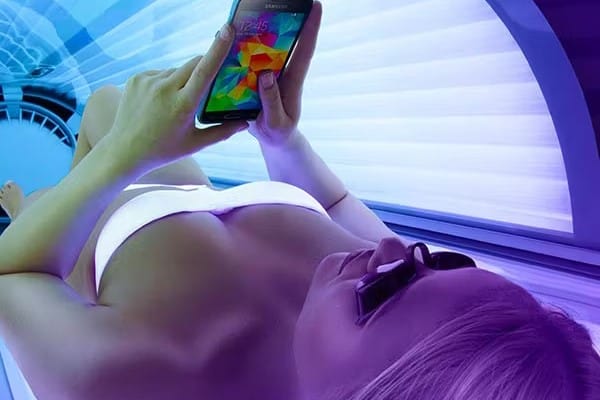
Technically, yes — there’s nothing stopping you from bringing your phone into a tanning bed. But there are three distinct reasons you probably shouldn’t, and they’re not the ones most people focus on. The biggest concern isn’t actually what the UV rays do to your phone. It’s what looking at your phone does to your eyes.
Key Takeaways
- The most important reason not to use your phone in a tanning bed is eye safety — actively looking at a screen means your eyes are open and unprotected from UV radiation.
- Heat is the genuine risk to your phone itself — tanning beds can exceed the 35°C operating limit of most smartphones, which affects the battery and internal components.
- UV from a single tanning session is unlikely to cause immediate screen failure — the risk is cumulative over many sessions and mainly affects surface coatings rather than the screen electronics.
- Tanning lotion on your hands transfers to your phone screen and ports, damaging the oleophobic coating and leaving product residue in speaker grilles and charge ports.
- Many salons prohibit phone use in tanning rooms for privacy reasons — check your salon’s policy before assuming it’s allowed.
- The practical solution for most people: queue up music or a podcast before you get in, use wireless earbuds, and leave the phone outside the bed.
The Most Important Concern: Your Eyes, Not Your Phone
This is the issue the question most often overlooks, but it’s the one that actually matters most for your health.
UV radiation from tanning beds is intense enough to cause serious eye damage. The FDA requires tanning salons to direct every customer to wear protective goggles, because simply closing your eyes — or wearing ordinary sunglasses — doesn’t adequately block the level of UV emitted by tanning lamps. The requirement exists for good reason: UV exposure to the eyes can cause photokeratitis (essentially a sunburn of the cornea — painful and temporarily blinding), and repeated unprotected exposure contributes to long-term cataract development.
If you’re actively using your phone inside a tanning bed — watching videos, scrolling, texting — your eyes are open. Not partially, not occasionally, but consistently open and directed toward a screen rather than shielded by properly fitted goggles. The UV isn’t just coming from the lamps above you; it also reflects off the acrylic surface beneath you and from the interior of the bed. Eyes open in that environment, for the duration of a session, is a meaningful exposure risk every time you do it.
Even glancing at your phone repeatedly throughout a session — adjusting music, checking a message — adds up. Each time your eyes are open in the bed without proper eye protection, you’re accumulating UV exposure to some of the most sensitive tissue in your body.
This is the primary reason tanning professionals consistently advise against phone use during a session. Everything else is secondary to this.
What Heat Actually Does to Your Phone in a Tanning Bed
Moving on to what happens to the phone itself: the real risk is heat, not UV radiation.
Smartphones are engineered to operate within a specific temperature range — typically 0°C to 35°C (32°F to 95°F). Inside a running tanning bed, the combination of heat generated by the UV lamps and the enclosed space can push the ambient temperature beyond this range during a session. When that happens:
- The battery degrades faster. Lithium-ion batteries — the type used in virtually every smartphone — are sensitive to sustained heat above 35–40°C. Regular exposure to elevated temperatures accelerates battery wear, reducing capacity over time. In more extreme heat, a battery can swell — a condition known as thermal expansion — which puts pressure on the screen and internal components and, in rare but serious cases, can lead to leakage.
- The phone throttles performance. Most modern smartphones have built-in thermal protection that reduces processor speed when the device gets too hot — you may notice it becoming sluggish or unresponsive mid-session.
- The screen can malfunction temporarily. Very high internal temperatures can cause touchscreen responsiveness issues or temporary display anomalies, most of which resolve once the device cools down but which indicate the phone was operating outside its safe range.
For a single session in a reasonably well-ventilated bed, the heat risk to a modern phone is modest rather than catastrophic. The risk compounds with frequency — bringing your phone into every session, session after session, accelerates battery wear more meaningfully than the occasional one-off.
What UV Rays Actually Do to Your Phone (The Honest Assessment)
A common claim is that UV rays from a tanning bed will immediately damage LCD or OLED screens, fry the battery, or cause screens to turn black. This is significantly overstated for a standard 10–15 minute session.
Modern smartphones are used outdoors constantly — in direct sunlight, at the beach, in gardens. They’re not fragile glass boxes that shatter on first UV contact. Your phone’s screen, glass, and casing are already exposed to UV routinely.
Where UV exposure does cause genuine harm over time is to surface materials:
- The oleophobic coating on the screen — the layer that makes screens fingerprint-resistant and easy to swipe — can degrade with repeated UV exposure, leaving the screen feeling rougher and smearing more easily. This happens gradually over many exposures, not in one session.
- Plastic casings and phone cases — some plastics yellow or become brittle with prolonged UV exposure. Again, cumulative rather than immediate.
- Camera lens coatings — very minor degradation over extended time.
A single tanning session is not going to kill your OLED screen. Bringing your phone in repeatedly over months is where the cumulative UV effect on surface materials becomes worth thinking about — alongside the more significant heat concern.
The Tanning Lotion Problem
This one gets overlooked almost universally, but it’s surprisingly practical.
If you’ve applied tanning lotion before your session — which most people who use tanning beds do — that lotion is on your hands and skin. The moment you pick up your phone, the lotion transfers directly to the screen, into the charge port, and into the speaker grilles. Tanning lotions are thick, often oil-based formulas that don’t wipe off a phone screen the way a fingerprint does. They leave a residue that:
- Damages the oleophobic coating on the screen more aggressively than UV alone
- Can clog speaker grilles and muffle sound
- Can introduce moisture and product residue into charge ports and headphone jacks
- Is genuinely unpleasant to remove and often leaves a film even after wiping
If you’re going to bring your phone, handling it with lotion-covered hands is arguably worse for the device than the UV and heat risks combined over a short session.
Salon Rules: Many Salons Don’t Allow Phones
Beyond the personal risks, a number of tanning salons explicitly prohibit phones in tanning rooms — and the reason isn’t about your phone’s wellbeing. It’s privacy.
Tanning rooms are places where clients are partially or fully undressed. A phone capable of photography in or near a tanning room raises legitimate concerns about the privacy of other clients. Many salons have formal no-phone policies in their tanning areas, sometimes extending to the changing rooms adjacent to the beds.
Before assuming you can bring your phone in, check whether your specific salon has a policy on this. If they do, it’s likely enforced for serious reasons rather than arbitrary rules.
The Tan Quality Issue
Two smaller but real concerns for the quality of your tan:
If you’re holding your phone on your chest, stomach, or anywhere on your body, it creates a shadow — an area that doesn’t receive UV and therefore doesn’t develop colour. Depending on how you position your phone during a session, this can leave a visible uneven patch that you’ll notice afterward.
And distraction matters. One of the most common causes of overexposure in tanning beds is losing track of time — spending longer than intended because you’re absorbed in your phone. Most beds have timers, but if you’re absorbed in a video and don’t notice when the timer is approaching, you may not exit promptly. Consistent overexposure accumulates into real skin damage over time.
What to Do Instead
The good news is that the thing most people actually want from their phone in a tanning bed — music or audio entertainment — is easily solved without the phone going in at all.
- Wireless earbuds work perfectly. AirPods and similar earbuds can be used in a tanning bed without any issue — you queue up your playlist, podcast, or audiobook before you get in, press play, and leave the phone outside. The audio continues without needing to touch anything inside the bed.
- Queue your audio before you get in. Set your playlist or podcast playing before stepping into the bed, so you don’t need to interact with the phone at all during the session.
- Some salons have Bluetooth systems built into the tanning rooms — your phone can connect wirelessly from outside the room while you listen through the in-room speakers. Ask the staff if this is available.
- Use the time to switch off completely. Tanning sessions are typically 10–15 minutes — one of the few moments in a day when there’s a natural excuse to just lie still and not look at a screen. Some people find it surprisingly useful for decompressing.
If You’re Going to Bring Your Phone Regardless
If you’ve decided you want your phone with you no matter what, here’s how to minimise the risks:
- Keep it face down — reduces screen UV and heat exposure, and removes the temptation to look at it.
- Put it in a protective case — provides some insulation from heat and limits direct surface UV on the phone body.
- Keep it out of the lamp zone — don’t place it directly under the UV lamps. Keep it to the side or near your feet where UV intensity is lower.
- Don’t interact with it during the session — set your audio before entering and don’t look at the screen while the bed is running. This addresses the eye safety concern.
- Never charge your phone inside a tanning bed — charging generates heat from the battery, and combining charging heat with the ambient heat of the bed significantly elevates the battery risk.
- Wash your hands before touching it — if you can, apply lotion and then wash your hands before handling your phone to prevent the tanning lotion residue problem.
Frequently Asked Questions
Will a tanning bed damage my iPhone or Android phone?
A single session is unlikely to cause obvious, immediate damage. The main risks are cumulative: repeated heat exposure degrades the battery faster, and UV over many sessions can affect surface coatings like the oleophobic screen layer. The heat risk is more significant than the UV risk for a typical 10–15 minute session. If you bring your phone in frequently, the battery wear and coating damage will accumulate over weeks and months.
Can you use your phone in a tanning bed with goggles on?
You can technically wear goggles and look at a phone, but tanning goggles are quite small and designed specifically to block UV — they’re not comfortable for extended screen reading, and they narrow your field of vision significantly. More importantly, the recommendation from tanning professionals is to keep your eyes protected throughout the session, and repeatedly lifting or adjusting goggles to see your screen defeats the point of wearing them. It’s not a practical setup for sustained phone use.
Can I listen to music on my phone in a tanning bed?
You can listen to music without bringing your phone into the bed at all. Queue up your playlist before getting in, connect wireless earbuds, and leave the phone outside. The audio will continue playing. This is the cleanest solution — you get the music, the phone stays safe, and your eyes stay protected with goggles on throughout.
Will UV from a tanning bed ruin my phone screen?
Not from a single session — this risk is exaggerated in most coverage of this topic. Modern phone screens are designed to handle regular UV exposure from outdoor use. What UV does over many repeated sessions is gradually degrade the oleophobic coating (the fingerprint-resistant layer) and potentially affect plastic casing materials. The screen electronics themselves are not going to fail from a typical tanning session.
Do salons allow phones in tanning rooms?
Policies vary by salon. Many explicitly prohibit phones in tanning rooms due to privacy concerns — clients are undressed, and the presence of camera-capable devices raises understandable issues. Some salons enforce this strictly; others are more relaxed. Check with your specific salon before assuming phones are permitted, particularly if you plan to have it out and visible rather than stored in a bag or case.
What happens if I accidentally leave my phone in a tanning bed?
If your phone was in the bed for a full session, let it cool down completely before using it or charging it — place it in a cool, shaded location for 15–20 minutes. Don’t put it in the freezer or run it under cold water. Once it has cooled to room temperature, check whether it’s behaving normally. If the battery was already older or marginal, the heat exposure may have accelerated any existing degradation, but a one-time incident in a healthy phone is unlikely to cause permanent damage.
Conclusion
The short version: leave your phone outside the tanning bed. Not primarily because of what UV does to the screen (that risk is overstated for a single session), but because looking at a screen means your eyes are unprotected from UV radiation — which is a far more serious concern than anything that happens to your phone.
The practical workaround is simple: wireless earbuds, music queued before you get in, phone stays outside. You get the entertainment, your eyes stay protected, your phone stays cool, and your tan develops without an uneven shadow where you were holding the device.
For more on getting the best results from your tanning bed session, our guide on positions and technique in a tanning bed covers the practical tips that actually make a difference to your result.