
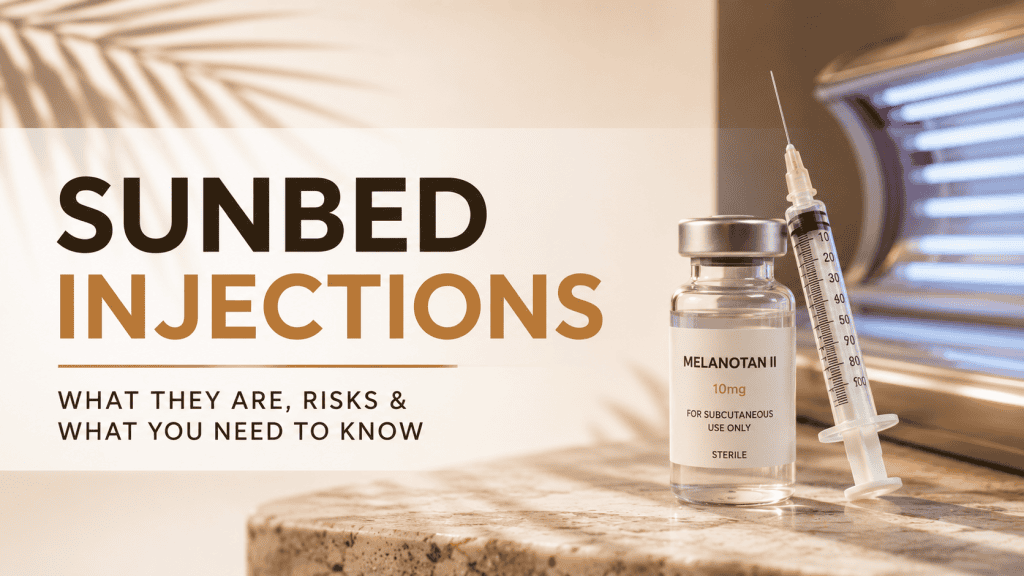
Tanning injections — also called “sunbed injections,” “tan jabs,” or the “Barbie drug” — are shots of a synthetic hormone called Melanotan that darkens your skin without the sun. They do produce a tan, but they’re unlicensed, illegal to sell and supply in the UK, and linked to side effects ranging from nausea to changing moles and, in rare cases, melanoma. In short: they work, but the safety trade-off is bad enough that no medicines regulator has approved them for tanning.
The “Barbie drug” nickname makes them sound harmless and fun. The reality is a lot less playful. Here’s what Melanotan actually is, why people use it, what the science and regulators say about the risks, and the far safer ways to get the same look.
Key Takeaways
- Tanning injections contain Melanotan, a synthetic version of the hormone that controls skin pigment. It genuinely darkens skin — but it’s a drug, not a cosmetic.
- It’s illegal to sell and supply Melanotan injections in the UK, and it isn’t approved for tanning anywhere (US, EU, Australia included).
- The “Barbie drug” nickname comes from its side effects: alongside tanning, it can suppress appetite and increase libido.
- Documented side effects include nausea, facial flushing, darkening and growth of moles, new moles, and prolonged erections in men.
- The biggest worry is skin cancer. Case reports link Melanotan use to melanoma, and mole changes can mask the early warning signs.
- Products are unregulated, so purity and dose are unknown — and injecting or sharing needles adds infection risk.
- Safer alternatives exist: DHA-based self-tanners and spray tans give colour with none of the drug risk.
What Are Tanning Injections (Melanotan)?
Melanotan is a lab-made copy of alpha-melanocyte-stimulating hormone (α-MSH), the natural hormone your body uses to make melanin — the pigment that colours your skin. There are two versions floating around the tanning world: Melanotan I and Melanotan II. Melanotan II is the one most people mean by “tanning injections” or the “Barbie drug.”
It works by switching on melanin production directly, chiefly through a receptor on your pigment cells called MC1R, boosting the darker eumelanin pigment independent of sun exposure [Habbema et al., Int J Dermatol, 2017]. In practice, users self-inject it under the skin (and sometimes use it as a nasal spray) to build a deep tan faster, often alongside sunbeds or sun exposure.
The catch is that Melanotan II isn’t selective. It doesn’t only talk to your skin — it activates related receptors throughout the body, which is exactly why the side effects spread well beyond a tan.
Why Is It Called the “Barbie Drug”?
The nickname comes from Melanotan II’s cluster of effects that, on paper, sound like a shortcut to a certain idealised look: darker skin, reduced appetite (and therefore weight loss), and increased sexual arousal. Because it acts on the brain as well as the skin, appetite suppression and raised libido are common effects for the people buying it [Habbema et al., Int J Dermatol, 2017].
Those “bonus” effects are a big part of why it spread — but they’re also a sign of how powerfully and unpredictably the drug acts on the whole body, not just your complexion.
Do Tanning Injections Actually Work?
Yes — that’s the uncomfortable part. Melanotan does produce a real, noticeable tan by ramping up melanin, and it can darken fair skin that normally struggles to tan at all. That effectiveness is precisely what makes it tempting for people with pale skin who burn easily.
But “it works” and “it’s safe” are two very different questions, and this is a case where the gap between them is enormous. A tan is a cosmetic outcome; the drug producing it is an untested, unlicensed hormone with a documented list of harms.
Are Tanning Injections Legal and Safe?
No, on both counts. It is illegal to sell and supply Melanotan injections in the UK, and the products have never been tested or approved for safety, quality, or effectiveness [Cancer Research UK]. The UK’s medicines regulator, the MHRA, has repeatedly warned the public against using them and has shut down numerous websites selling them. Regulators in the US, EU, and Australia take the same position — it’s unapproved everywhere.
Common side effects
The most frequently reported effects include nausea (very common), facial flushing, appetite loss, fatigue, headache, and spontaneous or prolonged erections in men. Many users also notice darkening of the skin in patchy, uneven ways rather than a smooth tan.
Moles, pigment changes, and skin cancer
This is the serious one. Because Melanotan stimulates pigment cells everywhere, it can darken and enlarge existing moles and trigger new ones, including atypical (dysplastic) moles [Habbema et al., Int J Dermatol, 2017]. There are multiple published case reports of melanoma — the most dangerous skin cancer — in Melanotan users [Hjuler & Lorentzen, J Am Acad Dermatol, 2014], including melanoma in situ [Ong & Bowling, Australas J Dermatol, 2012]. A direct cause-and-effect link isn’t fully proven, but there’s a second, subtler danger: by changing how your moles look, the drug can mask the very warning signs doctors rely on to catch skin cancer early.
Contamination and injection risks
Because these products are unregulated and often made in unknown facilities, you can’t be sure what’s actually in the vial or how concentrated it is. On top of that, injecting carries its own risks — infection, and cross-contamination if needles are shared. Rare but severe reactions reported in the literature include muscle breakdown (rhabdomyolysis) and kidney problems.
Is There a Legal, Approved Version?
Sort of — and it’s worth understanding the distinction. One α-MSH analogue, afamelanotide (brand name Scenesse), has been properly tested and approved, but only for a rare medical condition called erythropoietic protoporphyria, where sunlight causes severe pain [Habbema et al., Int J Dermatol, 2017]. That’s a prescription treatment used under medical supervision for a specific illness — completely different from buying unlicensed Melanotan II online to get a cosmetic tan. The existence of an approved medical cousin doesn’t make the gray-market tanning version safe.
What About Nasal Tanning Sprays?
Nasal sprays are the same drug (Melanotan II) in a different delivery format, and they’ve surged on social media platforms like TikTok, marketed at young people chasing a deep “natural” tan. They carry the same risks as the injections — unknown purity, pigment and mole changes, and the broader systemic side effects. Being sniffed rather than injected doesn’t make the underlying hormone any safer.
Safer Ways to Get a Tan
If you want colour without gambling on an unlicensed drug, sunless tanners are the answer. They use DHA (dihydroxyacetone), which reacts with the surface of your skin to create a temporary bronze that fades naturally — no hormones, no injections, and an ingredient that’s actually approved for cosmetic use. Our guide to DHA in tanning explains how it works.
For a foolproof at-home glow, start with how to self-tan at home. If you’d rather have it done professionally, spray tanning is safe when done properly, and spray tan vs self tan compares the two. Pale skin that struggles to tan naturally is often what pushes people toward Melanotan in the first place — our tanning tips for pale skin cover how to get a believable colour safely instead.
Frequently Asked Questions
What is the “Barbie drug”?
It’s a nickname for Melanotan II, a synthetic tanning hormone taken by injection or nasal spray. The name comes from its combination of effects: darker skin, appetite suppression, and increased libido.
Do tanning injections work?
Yes, they darken the skin by stimulating melanin, and can tan even fair skin. But they’re unlicensed, illegal to sell in the UK, and carry serious health risks, so working isn’t the same as being safe.
Are tanning injections legal in the UK?
No. It is illegal to sell and supply Melanotan injections in the UK, and they aren’t approved for tanning in the US, EU, or Australia either. The MHRA has warned against them and closed down supplier websites.
What are the side effects of Melanotan?
Commonly nausea, facial flushing, appetite loss, and prolonged erections in men. More seriously, it can darken and change moles, trigger new ones, and has been linked in case reports to melanoma.
Can Melanotan cause skin cancer?
There are multiple case reports of melanoma in users, though a definitive causal link isn’t proven. A separate concern is that Melanotan changes the appearance of moles, which can hide the early signs of skin cancer.
Are nasal tanning sprays safer than injections?
No. Nasal sprays contain the same drug (Melanotan II) and carry the same risks. The delivery method doesn’t reduce the danger of an unregulated hormone of unknown purity.
What’s a safe alternative to tanning injections?
DHA-based self-tanners and spray tans. They give real colour using a cosmetically approved ingredient, with none of the hormonal side effects or injection risks.
The Bottom Line
Tanning injections deliver on the tan — but the “Barbie drug” is an unlicensed, illegal-to-sell hormone with a genuinely worrying safety record, from changing moles and possible melanoma to unknown purity and injection risks. No tan is worth those odds, especially when the drug can mask the very warning signs that catch skin cancer early.
If your skin is pale and reluctant to tan, that’s a reason to reach for a good self-tanner, not a syringe. DHA-based products and professional spray tans give you the look safely — start with our self-tan at home guide. And if you’ve used Melanotan and noticed changing moles or other symptoms, it’s worth getting checked by your GP.
Research Sources
Melanotan Risks (Review):
Habbema et al., 2017, International Journal of Dermatology, “Risks of Unregulated Use of Alpha-Melanocyte-Stimulating Hormone Analogues: A Review” Comprehensive review of how melanotan I and II work, their reported dermatological and systemic risks, and the contrast with the one approved analogue, afamelanotide.
Melanoma & Melanotan II:
Hjuler & Lorentzen, 2014, Journal of the American Academy of Dermatology, “Melanoma Associated With the Use of Melanotan-II” Case report documenting melanoma developing in a user of Melanotan II.
Melanoma In Situ & Melanotan:
Ong & Bowling, 2012, Australasian Journal of Dermatology, “Melanotan-Associated Melanoma In Situ” Case report of melanoma in situ associated with Melanotan use, underscoring the concern around pigment-cell stimulation.
UK Regulatory Status & Safety:
Cancer Research UK, “Tanning, Fake Tan and Melanotan” Explains that Melanotan injections are illegal to sell and supply in the UK, that the products are untested for safety, and advises safer sunless alternatives.