
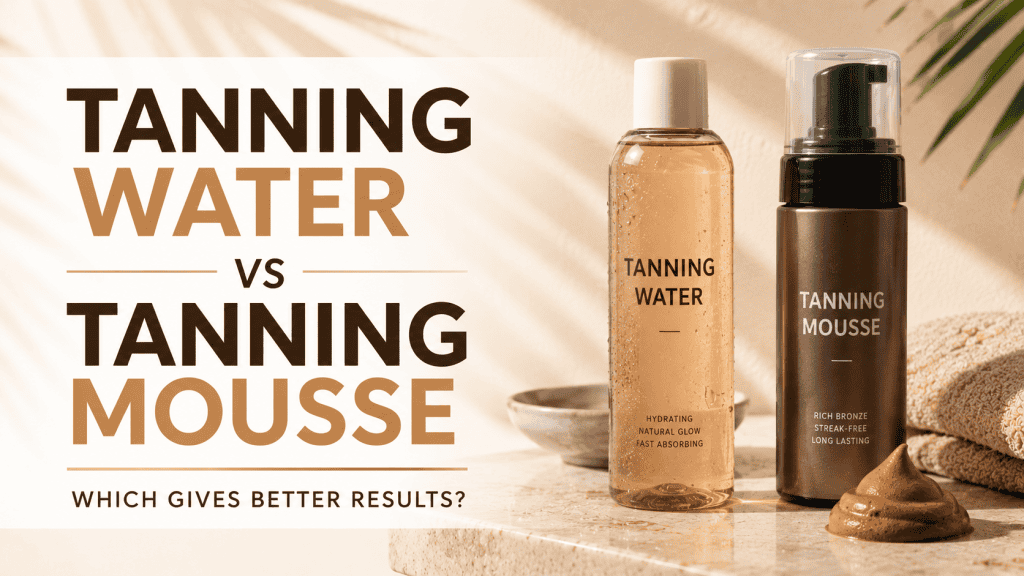
Tanning water and tanning mousse both use the same active ingredient — DHA (dihydroxyacetone) — to develop a sunless tan, but they feel and behave completely differently on the skin. Tanning water is a lightweight, clear mist that sinks in fast and builds a subtle, buildable glow with almost no mess. Tanning mousse is a foamed, usually tinted formula that gives a deeper, faster, more dramatic tan in a single application, but takes more skill to apply evenly.
If you want the short version: choose tanning water for an easy, natural, low-commitment glow (great for beginners and faces), and choose mousse when you want a rich, holiday-level tan and don’t mind a little more effort. But the “right” pick really depends on your skin, your patience, and how dark you actually want to go — so let’s break it all down.
Key Takeaways
- Same active, different delivery: Both rely on DHA, which reacts with the top layer of skin to create colour — neither involves UV or sun exposure.
- Tanning water is clear, lightweight, fast-absorbing, and beginner-friendly, but usually gives a lighter, more gradual tan with no guide colour to see where you’ve sprayed.
- Tanning mousse is tinted, buildable, and delivers a deeper tan faster — but it’s easier to streak and can transfer onto sheets before it develops.
- Best for your face? Tanning water. Best for a deep body tan? Mousse.
- Neither protects you from the sun — a sunless tan offers little to no meaningful SPF, so you still need sunscreen.
- Our favourites: Isle of Paradise Self-Tanning Water for water and Bondi Sands Self-Tanning Foam for mousse, with a few strong alternatives below.
What Is Tanning Water?
Tanning water is a clear, watery mist you spray onto your skin, then blend in with a mitt. It contains water, skin-friendly ingredients (like hyaluronic acid, glycerin, or vitamin E), and DHA — the same tanning active found in nearly every sunless product on the market.
The big appeal is how light it feels. It absorbs almost instantly, doesn’t leave a sticky film, and because it’s clear, it won’t rub off onto your clothes or bedding while it develops. That makes it ideal for a quick morning application before work or even a top-up under makeup.
The trade-off? There’s no guide colour. Since the formula goes on invisible, you can’t see exactly where you’ve already sprayed, so it’s easy to miss patches if you rush. Working in sections and blending carefully with a mitt solves most of this. If you’re brand new to fake tan, our guide to self-tanning at home walks through the whole process step by step.
Pros of Tanning Water
- Extremely lightweight and fast-absorbing
- Clear formula — minimal transfer onto clothes and sheets
- Buildable, natural-looking colour that’s hard to overdo
- Great for the face and for daily, gradual glow-building
- Often packed with hydrating skincare ingredients
Cons of Tanning Water
- No guide colour, so missed patches are easy if you’re careless
- Usually gives a lighter tan — not ideal if you want deep, instant colour
- Can take a few hours to fully develop
What Is Tanning Mousse?
Tanning mousse (also called self-tanning foam) is a whipped, airy formula that’s usually tinted with a cosmetic guide colour. You pump it onto a mitt and sweep it over your skin, and the tint shows you exactly where you’ve applied — which is a huge advantage for even coverage.
Mousse is the go-to when you want a proper, noticeable tan. It tends to be more concentrated, develops faster, and can take you from pale to genuinely bronzed in a single application. Many formulas are “express,” letting you control the depth by how long you leave them on before rinsing.
The downside is that mousse demands a bit more technique. Because it’s richer, it can cling to dry areas like knees, ankles, and elbows, and the guide colour can transfer onto light clothing or sheets before you shower it off. Prepping properly with exfoliation and moisturiser makes a massive difference — see our tips on making self-tanner last longer.
Pros of Tanning Mousse
- Tinted guide colour makes even application much easier
- Delivers a deeper, more dramatic tan, often faster
- Buildable and controllable depth with “express” formulas
- Best choice for a full-body holiday glow
Cons of Tanning Mousse
- Can streak or cling to dry patches without good prep
- Guide colour may transfer onto clothes and bedding before rinsing
- Slightly steeper learning curve than water
Tanning Water vs Tanning Mousse: Head-to-Head
Here’s how the two stack up on the things that actually matter when you’re standing in the bathroom deciding what to reach for.
- Ease of application: Mousse wins for visibility thanks to the guide colour, but water wins for how quickly and cleanly it goes on. Beginners often find water more forgiving overall.
- Depth of colour: Mousse takes it — it’s built for deeper, faster results. Water gives a lighter, more gradual glow.
- Mess and transfer: Water is the clear winner. It’s colourless and barely transfers, while mousse’s tint can end up on your sheets.
- Best for the face: Water, hands down. It’s lightweight, can be applied under makeup, and is easy to build subtly.
- Best for the body: Mousse, especially if you want serious colour for a holiday, event, or wedding.
- Hydration: Both can be hydrating depending on the formula, but water-based mists often lean more skincare-forward.
How DHA Works in Both Formulas
Whichever you choose, the science is the same. DHA reacts with amino acids in the outermost layer of skin to produce a temporary brown colour through a process similar to the browning of food, and this colour typically develops over several hours and fades as your skin naturally sheds [Braunberger et al., J Drugs Dermatol, 2018]. Because the effect is only skin-deep, both water and mousse give a tan that gradually wears off over roughly 5–10 days.
DHA has a long track record in cosmetics and is generally considered safe for topical use in sunless tanning products, though it’s sensible to avoid inhaling sprays and to keep it away from the eyes and lips [Owji et al., Photodermatol Photoimmunol Photomed, 2023]. If you want to go deeper on the ingredient itself, we cover it fully in our DHA skincare and tanning guide.
One important note for both formulas: a DHA tan is not sunscreen. It offers little meaningful protection against UV rays, so you still need proper SPF whenever you’re in the sun. Our guide to tanning with sunscreen explains how to layer protection without ruining your glow.
Our Favourite Tanning Waters
Tanning waters have exploded in popularity because they make sunless tanning feel effortless. These are the ones we keep coming back to.
Best Overall: Isle of Paradise Self-Tanning Water
This is the tanning water most people mean when they say “tanning water.” The Isle of Paradise Self-Tanning Water comes in light, medium, and dark, sinks in fast, and builds a believable glow. It’s a great everyday option for gradually deepening your tan without committing to a dramatic result all at once. Take your time blending — because it’s clear, working in sections is key to avoiding missed patches.
Best Hydrating Pick: Tan-Luxe The Water
If your skin runs dry, the Tan-Luxe The Water is a favourite. It’s infused with hydrating ingredients like raspberry seed oil and vitamin E, develops into a golden, streak-free glow, and won’t transfer onto clothes or sheets thanks to the clear formula. It’s a lovely one for the face and a subtle all-over glow.
Best Foaming Water: Bondi Sands Pure Self-Tanning Foaming Water
A hybrid between water and foam, the Bondi Sands Pure Self-Tanning Foaming Water applies smoothly, is loaded with skincare ingredients like hyaluronic acid and vitamins C and E, and gives a natural golden tone over a few hours. A solid pick for total beginners who want the light feel of water with a slightly easier application.
Our Favourite Tanning Mousses
When you want real, noticeable colour, mousse is the move. These consistently deliver.
Best Overall: Bondi Sands Self-Tanning Foam
Hard to beat for the price. The Bondi Sands Self-Tanning Foam dries quickly, gives a natural, long-lasting tan, and comes in light/medium and dark. It applies fast and blends evenly with a mitt — just work quickly, since it can get slightly tacky. The coconut scent is divisive, but the results speak for themselves.
Best Luxe Finish: St. Tropez Self Tan Classic Bronzing Mousse
A long-standing favourite for a reason. The St. Tropez Self Tan Classic Bronzing Mousse is lightweight, melts into the skin, and fades evenly without patchiness. It’s pricier than most, but the natural, streak-free finish and pleasant scent make it worth it for special occasions.
Best for a Deep Tan: Loving Tan 2HR Express Mousse
If you want the darkest, most dramatic glow, the Loving Tan 2HR Express Mousse is a cult favourite. It develops fast, delivers rich colour, and lasts well — though its intensity means careful prep and blending really matter. Best suited to those who already know their way around a tanning mitt.
Whichever mousse you pick, a good tanning mitt is essential for streak-free results.
Which One Should You Choose?
Here’s the simplest way to decide:
- Go for tanning water if you’re a beginner, you mainly want to tan your face, you like a subtle glow you can build over days, or you hate the mess and transfer of traditional tanners.
- Go for tanning mousse if you want a deep, holiday-ready tan, you’re happy to spend a few minutes on careful application, or you need noticeable colour for a specific event.
Plenty of people keep both in rotation — mousse for a big night out or holiday, and water for easy, everyday top-ups. There’s no rule that says you have to pick just one.
Frequently Asked Questions
Is tanning water or mousse better for beginners?
Tanning water is generally more beginner-friendly because it’s lightweight, fast-absorbing, and hard to overdo. The main challenge is that it’s clear, so you can’t see where you’ve applied — working in sections with a mitt solves that. Mousse gives more dramatic results but takes a bit more skill.
Does tanning water or mousse last longer?
Both fade over roughly 5–10 days as your skin naturally sheds, since they use the same DHA active. Mousse often looks like it lasts longer simply because it starts darker, but a good skincare routine — moisturising daily and avoiding harsh exfoliation — extends either one.
Which gives a darker tan, water or mousse?
Mousse. It’s typically more concentrated and buildable, so it delivers deeper, faster colour in a single application. Tanning water gives a lighter, more gradual glow, though you can build it up over repeated uses.
Can I use tanning water on my face?
Yes — tanning water is one of the best options for the face because it’s light, sinks in quickly, and can even be applied under makeup. Just avoid the eye and lip area, and blend well. Our guide to self-tanning your face has more detail.
Does tanning water transfer onto clothes and sheets?
Much less than mousse. Because tanning water is clear, there’s minimal guide colour to rub off, so it’s far less likely to stain your clothes or bedding while it develops. Tinted mousse can transfer before you rinse, so it’s worth wearing loose, dark clothing while it sets.
Do tanning water and mousse protect against the sun?
No. A sunless tan from either offers little to no meaningful sun protection, so you still need to wear sunscreen whenever you’re outdoors. Never skip SPF just because your skin looks tanned.
Can you use tanning water and mousse together?
You can. Many people use mousse for a deep base tan and then top up with tanning water in between to keep the colour going without a full reapplication. Just make sure your base has fully developed before layering.
The Bottom Line
Tanning water and tanning mousse both rely on DHA to give you a real tan without the sun, but they suit different needs. Tanning water is the easy, low-mess, beginner-friendly choice for a natural, buildable glow — especially on the face. Mousse is your pick when you want deeper, faster, holiday-level colour and don’t mind a little more effort getting it even.
If you only try one, start with a tanning water like Isle of Paradise to get comfortable, then graduate to a mousse like Bondi Sands when you’re ready to go darker. And whichever you choose, keep the SPF handy — a sunless glow looks best on healthy, protected skin. For a wider look at your options, check out our full guide to the different types of tanning.
Research Sources
DHA (self-tanning mechanism):
Braunberger TL, et al., 2018, J Drugs Dermatol, “Dihydroxyacetone: A Review” A review of dihydroxyacetone confirming it reacts with the outer layer of skin to produce a temporary, superficial tan that fades as skin cells shed.
DHA (safety in sunless tanning products):
Owji S, et al., 2023, Photodermatol Photoimmunol Photomed, “Properties and safety of topical dihydroxyacetone in sunless tanning products: A review” A review of the properties and safety profile of topical DHA, supporting its use as a generally safe sunless tanning active with sensible precautions.