
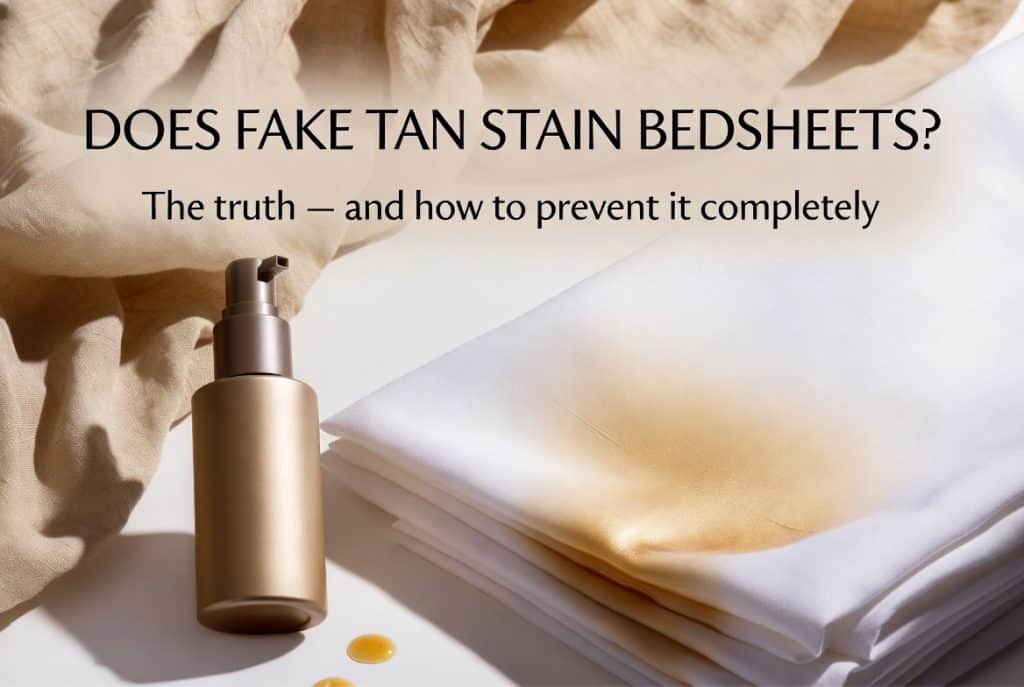
Yes, fake tan can stain bedsheets — but the good news is it almost always washes out. Most of what transfers to your sheets is the cosmetic guide colour (the temporary bronzer tint added so you can see where you’ve applied), which is water-soluble and lifts in a normal wash. The actual tan can transfer a little too, especially if your skin is damp, but with quick treatment your sheets will come clean.
The trick is knowing the difference between the two types of marks, treating them the right way, and — even better — preventing most of the transfer in the first place. Here’s exactly how.
Key Takeaways
- Fake tan can mark sheets, but it usually isn’t permanent. Treated promptly, both the guide colour and the tan itself come out.
- Most staining is the guide colour — a cosmetic, water-soluble bronzer tint — not the DHA that actually tans your skin.
- Act fast. Fresh marks lift far more easily than ones left to set.
- Flush from the back with cold water first, then treat with a detergent solution — never hot water, which sets the stain.
- For stubborn or white-sheet stains, soak overnight in cold water and oxygen-based (not chlorine) bleach.
- Prevent it by letting your tan dry fully before bed, using old or dark sheets, and choosing clear, no-guide-colour formulas.
Does Fake Tan Actually Stain Sheets?
It can, but it’s rarely the disaster people fear. To understand why, it helps to know that most self-tanners contain two separate things: the active tanning ingredient and a cosmetic guide colour.
The active ingredient, DHA (dihydroxyacetone), reacts with the amino acids in the surface layer of your skin to create the tan (Braunberger et al., J Drugs Dermatol, 2018). Your cotton sheets don’t have skin’s proteins to react with in the same way, so the tan doesn’t “dye” them the way it colours you. What actually marks the fabric is mostly the guide colour — a temporary, water-soluble tint — plus a bit of the product’s moisturising base and unreacted tanning solution that rubs off before it’s had time to develop.
Because the guide colour is cosmetic and water-soluble, it typically rinses straight out. The transferred tanning solution can leave a faint mark if it’s left to sit, but caught early it lifts easily too. So yes, fake tan can stain sheets — but “stain” usually means “washes out with a bit of care,” not “ruined forever.”
Why Fake Tan Transfers to Your Sheets
A few things make transfer more likely, and most of them are easy to avoid:
- Getting into bed before it’s dry. This is the big one. If the tan is still tacky, it rubs straight onto the sheets. Knowing how long self-tanner takes to dry matters here.
- Overnight-developing formulas. Many tans need 6–8 hours to develop, which means hours of contact with your bedding while it sets.
- Sweating or warmth. Body heat and a warm room can loosen fresh product, so it migrates onto sheets. This is a common issue in summer.
- Heavy guide colour. Deeply tinted mousses and sprays have more cosmetic colour to transfer than clear formulas.
How to Stop Fake Tan Staining Your Sheets
Prevention is far easier than removal. A few small habits keep your bedding clean:
- Let your tan dry completely before bed. Touch-dry isn’t enough — give it at least 10–15 minutes, and longer if you can. Our tips on how to dry fake tan quickly help here.
- Apply earlier in the day when possible. Tanning in the morning or afternoon lets the colour develop and set before you ever get near your sheets.
- Wear loose, old pyjamas. Baggy cotton in a dark colour protects both your tan and your bedding.
- Use old or dark sheets on tan nights. Keep a dedicated set for developing your tan, and lay an old dark towel over your pillow.
- Choose a clear, no-guide-colour formula. Colourless tans eliminate the guide-colour transfer that causes most sheet marks. A clear water-based option like St. Tropez Self Tan Purity Bronzing Water develops without any tint to rub off, so there’s far less to wash out.
If you regularly develop your tan overnight, it’s worth reading whether you should sleep in self-tanner at all, and how to do it cleanly.
How to Get Fake Tan Out of Sheets
Already got marks on the bedding? Don’t panic — work through these steps and act as quickly as you can, because fresh stains lift far more easily than set ones.
- Flush the back of the stain with cold water. Turn the sheet inside out and run cold water through the reverse of the mark. This pushes the tanner back out of the fibres rather than deeper in. Avoid hot water — heat sets the stain.
- Make a detergent solution. Mix roughly two parts cool water to one part liquid laundry detergent (or dish soap in a pinch).
- Dab, don’t scrub. Blot the solution onto the stain, working from the outer edge inward so it doesn’t spread. Scrubbing can push the colour deeper.
- Rinse and repeat. Alternate cold-water rinsing and dabbing until the mark fades. Most guide-colour marks disappear at this stage.
- Wash as normal — then air dry. Launder on a cold or cool cycle with your usual detergent, then let the sheets air dry and check the result. Do not tumble dry until you’re sure the stain is fully gone, because the dryer’s heat will lock in anything left behind.
For stubborn or white-sheet stains
If a mark survives the first round (more likely on white bedding), soak the sheets overnight in cold water with an oxygen-based stain remover such as OxiClean Versatile Stain Remover, mixed per the package directions, then wash as usual. A biological (enzyme) detergent soak works well too. Repeat if needed before ever putting the sheets in the dryer.
A quick note on what to avoid
Skip hot water and the tumble dryer until the stain is completely gone, since heat sets it permanently. Avoid chlorine bleach as well — it can react with the tanning ingredients and make things worse, and it’s rough on fabric. Oxygen-based bleach is the safer, more effective choice for tan. The same principles apply if the tan ends up on clothing rather than bedding — here’s how to get tan out of clothes.
Frequently Asked Questions
Does fake tan come out of sheets?
Yes, in almost all cases. The guide colour is water-soluble and usually washes out completely, and the transferred tan lifts too if you treat it promptly with cold water and detergent. The main thing that causes permanent marks is heat — hot water or the dryer — so avoid both until the stain is gone.
Will fake tan permanently stain sheets?
Rarely, as long as you act quickly and keep heat away from the stain. Fresh marks come out easily; the risk of a permanent stain rises only if the mark is left to set for a long time or is run through a hot wash or dryer before it’s removed.
Does fake tan stain white sheets more?
The marks are more visible on white sheets, but they’re also very treatable. Start with the cold-water and detergent method, then soak overnight in cold water with an oxygen-based stain remover for anything stubborn. Avoid chlorine bleach.
Can you sleep in fake tan without staining your sheets?
Yes, if you take a few precautions: let the tan dry fully first, wear loose dark pyjamas, and sleep on old or dark sheets. Better still, use a clear, no-guide-colour overnight formula, which has no tint to transfer in the first place.
Does fake tan wash out in the washing machine?
Usually yes — the guide colour lifts in a normal cold wash. For the best result, treat the stain by hand first, wash cold, and air dry so you can check it’s gone before any tumble drying.
How do you get fake tan off a mattress?
Because you can’t rinse a mattress, blot rather than soak. Dab the area with a cloth dampened in cold water and a little mild detergent, working from the outside in, then blot with clean water and let it air dry. A waterproof mattress protector prevents the problem entirely.
The Bottom Line
Fake tan can leave marks on your sheets, but it’s almost never permanent. Most of what transfers is the water-soluble guide colour, which washes out easily, and even the tan itself comes clean if you flush it with cold water, treat it with detergent, and keep it away from heat until it’s gone. For anything stubborn, an overnight soak in oxygen-based stain remover does the trick.
Best of all, a little prevention means you’ll rarely deal with it: let your tan dry fully, sleep on old dark sheets, and reach for a clear formula when you can. For more on getting a clean, long-lasting result, see our guides on self-tanning at home and making your tan last longer.
Research Sources
DHA Mechanism & Overview:
Braunberger et al., 2018, Journal of Drugs in Dermatology, “Dihydroxyacetone: A Review” Explains how DHA reacts with amino acids in the surface layer of skin to create colour — a reaction specific to skin, which is why the tan itself doesn’t dye fabric the way the cosmetic guide colour marks it.