
The UV index is the most practical tool available for deciding when to tan, how long to stay out, and how much protection you need. Understanding what the numbers actually mean — and how they interact with your skin type — makes the difference between a gradual, even tan and an uncomfortable burn that peels everything off within a week.
The UV index measures the intensity of ultraviolet radiation reaching the Earth’s surface at a given time and place. It runs from 0 (essentially no UV) to 11+ (extreme). For tanning purposes, a UV index of 3 to 6 is the practical sweet spot for most skin types — enough UV to stimulate melanin production effectively, but without the rapid burn risk that comes with higher readings.
Here is the full picture: what the scale means, how your skin type changes the equation, and how to use this information to get a better tan with less risk.
Key Takeaways
- The UV index runs from 0 to 11+ and measures the combined erythema-weighted intensity of UVA and UVB radiation at a specific location and time.
- A UV index of 3–6 is the most practical range for tanning — sufficient to trigger melanin production while giving you a reasonable time window before burn risk becomes significant.
- Below UV 3, tanning is possible but very slow for most skin types, particularly fair skin.
- Above UV 7, burn risk escalates rapidly and unprotected exposure windows shorten to 15 minutes or less for fair skin.
- Your Fitzpatrick skin type determines how quickly you burn at any given UV level — fair skin (Type I–II) requires far shorter exposure times than medium or darker skin.
- UVA drives immediate skin bronzing; UVB triggers delayed melanin production — both are needed for a lasting tan.
- SPF 30 broad-spectrum sunscreen is still recommended at every UV level during intentional tanning sessions.
- UV index is affected by time of day, season, altitude, cloud cover, and location — the same number means different things in different places.
What the UV Index Scale Actually Means
The UV index was developed in the early 1990s and standardised globally by the World Health Organization and the World Meteorological Organization as a consistent way to communicate UV radiation risk. It weights the incoming UV spectrum according to how damaging different wavelengths are to human skin, with particular emphasis on UVB’s burn-causing potential. A UV index of 1 at sea level in January is a very different biological event from a UV index of 1 at high altitude in summer — but the index gives you the most practically useful single number for your current conditions.
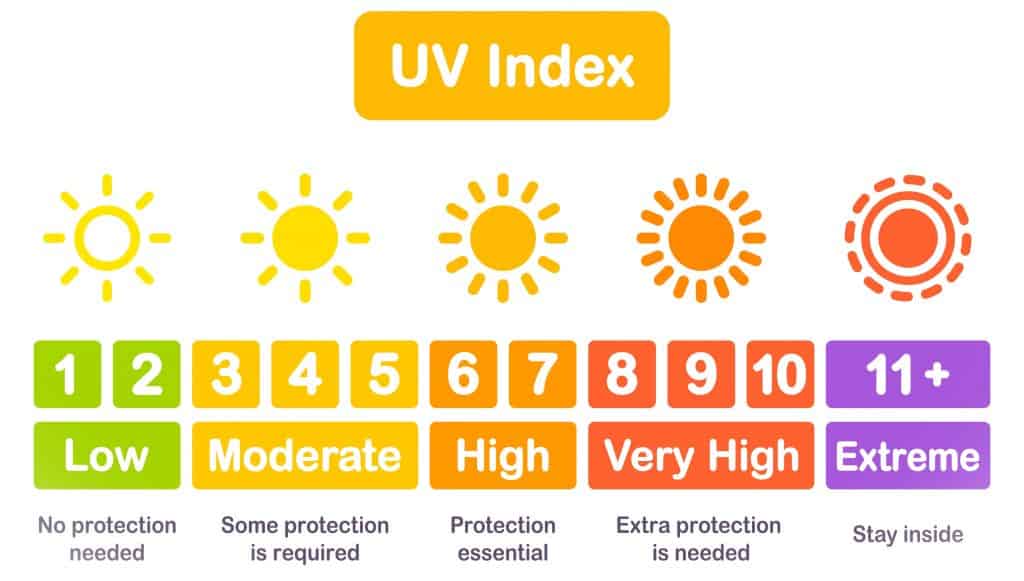
Here is how the scale breaks down:
- 0–2 (Low): Minimal UV reaching the surface. Tanning is possible at the upper end (1–2) but extremely gradual. Primarily occurs at night (0), on heavily overcast winter days, or at very high latitudes. Burn risk is low but not zero at UV 2.
- 3–5 (Moderate): The practical tanning window for most people. Sufficient UVB to stimulate meaningful melanin production. Burn risk is present but manageable with appropriate session lengths. Typical of spring and autumn sunny days, or cloudy summer days.
- 6–7 (High): Tanning occurs faster, but burn risk escalates significantly. Fair skin types need to be cautious about time in the sun. Typical of sunny spring/summer days in temperate climates.
- 8–10 (Very High): Rapid tanning possible, but burn risk for unprotected skin is very significant — fair skin can burn in under 15 minutes. Typical of peak summer days and tropical or high-altitude locations.
- 11+ (Extreme): Burn risk within minutes for unprotected fair skin. Not a practical tanning window — protective measures are essential. Common in tropical zones and at high altitude during summer.
How UVA and UVB Drive Tanning Differently
Both UV types contribute to tanning, but through different mechanisms and on different timescales — and understanding this helps explain why the UV index alone does not tell the whole story.
UVA (wavelengths 315–400 nm) penetrates deeper into the dermis and causes the immediate bronzing effect you notice within hours of sun exposure. It does this by oxidising existing melanin already present in the skin cells, darkening it quickly. This initial UVA-driven colour tends to fade relatively quickly as it involves no new melanin synthesis. UVA rays are present throughout daylight hours and penetrate clouds and glass — they are responsible for much of the cumulative photoageing associated with sun exposure [Tran et al., International Journal of Molecular Sciences, 2025].
UVB (wavelengths 280–315 nm) targets the epidermis and drives the delayed tanning response — the deeper, longer-lasting colour that develops over 24–72 hours after exposure. UVB stimulates melanocytes to synthesise new melanin and triggers the melanocyte-stimulating hormone cascade that distributes that melanin into surrounding skin cells, providing more durable colour and some protection against subsequent UV exposure. UVB is also the primary cause of sunburn, and its intensity varies much more dramatically throughout the day and across seasons than UVA.
A lasting tan requires both: UVA for initial colour, UVB for the sustained pigmentation underneath. This is why late afternoon tanning (predominantly UVA) produces a more fleeting result than midday exposure — the UVB component responsible for durable melanin production is lower. For more on this, see our article on whether you can get a tan after 4pm.
What UV Index Is Best for Tanning?
For most skin types, a UV index of 3 to 6 represents the most practical and manageable range for intentional tanning. Here is why:
At UV 3, melanin production is meaningfully triggered in most skin types. You have a reasonable exposure window — around 20–30 minutes for medium skin tones before burn risk becomes significant — and the overall UV dose per session is lower, making it easier to build colour gradually without setbacks. At UV 5–6, the process accelerates. Tanning is more efficient and visible results come more quickly, but your time window before burn risk narrows. This is the upper end of the manageable range for fair skin types.
At UV 7 and above, tanning is technically faster but the margin for error shrinks significantly. Fair and medium skin types are at real burn risk within 15–20 minutes of unprotected exposure. At UV 8 and above, dermatologists universally recommend avoiding prolonged unprotected exposure — even with SPF, the UV dose accumulates rapidly and any tanning goal is better deferred to a lower-index day or shifted to early morning or late afternoon sessions.
If you want to tan faster without burning, our guide on how to tan darker and faster outside covers the full strategy including timing, rotation, and SPF use.
UV Index and Skin Type: The Fitzpatrick Scale
The UV index tells you how intense the radiation is — your Fitzpatrick skin type tells you how your skin responds to it. The two together determine your practical safe exposure window at any given UV level.
The Fitzpatrick scale, developed by dermatologist Thomas Fitzpatrick in 1975, classifies skin into six types based on melanin content and characteristic response to UV exposure:
- Type I — Very fair: Always burns, never tans. Pale skin, often with red or blonde hair, blue or green eyes, freckles. At UV 5, unprotected burn risk begins within 10–15 minutes. UV tanning is not practical for this skin type — self tanner is a far better option.
- Type II — Fair: Burns easily, tans minimally. Light skin, often blonde hair. Can develop slight colour over multiple short sessions at UV 3–5, but burn risk remains high. Sessions should be kept to 15–20 minutes maximum at UV 3–4.
- Type III — Medium: Burns moderately, tans gradually to light brown. This skin type gets the most practical benefit from UV index 3–6. Tanning is achievable with 20–30 minute sessions and appropriate SPF use.
- Type IV — Olive: Burns minimally, always tans well. Light brown or olive skin. Tans readily at UV 3–7 with a 30–45 minute window before significant burn risk at moderate UV levels.
- Type V — Brown: Rarely burns, tans darkly. Can work with a wider UV range, though UV-induced DNA damage and photoageing accumulate regardless of visible burn response.
- Type VI — Dark brown/black: Never burns, always tans darkly. Highest natural UV protection, but still at risk for cumulative DNA damage and photoageing with repeated unprotected exposure.
For a detailed guide on tanning strategies specific to fair and pale skin, see our article on tanning tips for pale skin.
UV Index by Time of Day
The UV index is not constant throughout the day. It peaks around solar noon — roughly 12pm to 2pm in most locations — and drops off significantly in the morning and late afternoon. This has direct implications for tanning strategy:
- Before 10am: UV index is typically low (1–3 in summer), making tanning slow but burn risk minimal. Useful for building a very gradual base over time.
- 10am–4pm: The high-UV window. Tanning is fastest, but so is burn risk. Fair skin types should limit unprotected exposure significantly during this period on high-UV days.
- After 4pm: UV index drops back into moderate or low range. UVA remains active but UVB weakens. Tanning is slower but burn risk is substantially reduced — a practical window for fair skin. See our full guide on tanning after 4pm for more detail.
What Affects UV Index Beyond the Time of Day
Several factors can significantly modify the UV index at your location beyond just time of day:
- Altitude: UV intensity increases by roughly 10–12% for every 1,000 metres of elevation. A UV index of 6 in a mountain resort is meaningfully more intense than UV 6 at sea level.
- Cloud cover: Clouds reduce UV but do not eliminate it. Light cloud cover can allow 70–90% of UV through. You can still tan — and burn — on overcast days. For more, see our article on tanning on cloudy days.
- Reflective surfaces: Sand, water, and snow all reflect UV radiation, significantly increasing your effective UV dose. Beach tanning at UV 6 involves considerably more UV exposure than the index suggests on its own.
- Season and latitude: In northern latitudes (UK, northern US, Canada), peak summer UV indexes of 7–9 are common. In tropical or southern locations, 10–12 is achievable even outside peak summer.
- Ozone layer: Ozone absorbs a significant portion of UVB. Regional ozone variations can affect UV index meaningfully, particularly at higher latitudes.
Does Temperature Affect Tanning?
Temperature has no direct effect on tanning whatsoever. UV radiation — not heat — is what drives melanin production. You can get a tan in cold conditions if the UV index is sufficient, and you can sit in very high heat with no UV (such as in an indoor sauna) and develop no tan at all. This is one of the most common misconceptions about sun tanning. For a full explanation, see our article on how hot it has to be to tan.
Sun Protection at Every UV Level
SPF does not prevent tanning — it slows it by filtering a portion of UVB — but it significantly reduces burn risk and cumulative UV damage. SPF 30 blocks around 97% of UVB rays, still allowing enough through for gradual melanin production. Broad-spectrum formulas additionally protect against UVA, which SPF ratings alone do not measure.
The recommendation remains the same at every UV level: apply broad-spectrum SPF 30 before going out, and reapply every two hours. This is particularly important given that UV-induced skin damage accumulates regardless of whether a visible burn occurs. For a full breakdown of how SPF interacts with the tanning process, see our article on tanning with sunscreen.
Your eyes, lips, and scalp are the most UV-sensitive areas and are frequently overlooked. UV-protective sunglasses, an SPF lip balm, and a hat or UV-protective hair product are worth including in any tanning routine.
Checking Your Real-Time UV Index
The quickest way to check your current UV index is through your phone’s weather app — most display it directly on the forecast screen. You can also use weather service websites or dedicated UV monitoring apps. The EPA’s UV Index tool provides real-time readings by US zip code. UV forecasts are typically updated hourly, making it straightforward to plan your sessions around the best window for your skin type and tanning goals.
Final Thoughts
The UV index is the single most useful piece of information you can have before a tanning session. A reading of 3–6 is the practical sweet spot for most people — enough UV to produce a meaningful melanin response without the compressed burn window that comes with higher readings. Pair that with your Fitzpatrick skin type to determine your safe exposure time, apply SPF 30, and reapply every two hours.
The best tan is built gradually over multiple sessions, not chased aggressively in a single afternoon. Low-to-moderate UV index days consistently produce better outcomes than peak-UV sessions that end in a burn and a week of peeling. For a complete guide to timing and strategy, our article on the best time to tan outside covers the full picture including season, location, and skin type.
Frequently Asked Questions
What UV index is good for tanning?
A UV index of 3–6 is the most practical range for tanning. This is sufficient to stimulate meaningful melanin production in most skin types while giving you a manageable exposure window before burn risk becomes significant. At UV 7 and above, tanning occurs faster but burn risk escalates rapidly for fair and medium skin types.
Can you get a tan with a UV index of 5?
Yes — UV 5 is well within the range that triggers melanin production for all skin types except very fair (Fitzpatrick Type I). For medium to darker skin types, a 20–30 minute session at UV 5 with appropriate SPF use is an efficient and manageable approach. Fair skin types should keep sessions shorter — 10–15 minutes — at this level.
What is the minimum UV index needed to tan?
Melanin production technically begins at UV 1, but at that level the response is so minimal that visible tanning is extremely slow for most people. A UV index of 3 is where most skin types start to see meaningful colour development within a practical session length.
Is UV index 6 safe for tanning?
UV 6 is classified as high and can produce a visible tan relatively quickly, but burn risk is elevated at this level — particularly for fair and medium skin types. If tanning at UV 6, keep sessions shorter than you would at UV 3–5, apply SPF 30, and stay alert for the first signs of redness.
What UV index is too high to tan safely?
At UV 8 and above, the burn risk is significant enough that dermatologists recommend against prolonged unprotected sun exposure for any skin type. If the UV index is very high or extreme, shift your session to before 10am or after 4pm when the index will be lower, or defer to a lower-UV day.
Does the UV index change throughout the day?
Yes, significantly. It peaks around solar noon (roughly 12–2pm), drops sharply in the early morning and late afternoon. On a day with a peak UV index of 8, the index may only be 3–4 at 8am and 4pm — making those earlier and later windows much more manageable for tanning.
What is the best temperature for tanning?
Temperature has no effect on tanning — UV radiation is what drives melanin production, not heat. You can tan in cold weather if the UV index is sufficient, and sitting in heat with no UV produces no tan. Only the UV index matters for tanning purposes.
Related Articles
- Best Time to Tan Outside — Full Guide
- Can You Get a Tan After 4pm?
- How to Tan Darker and Faster Without Burning
- Can You Tan With Sunscreen?
- Tanning Tips for Pale Skin
- Can You Tan on Cloudy Days?
- How Hot Does It Have to Be to Tan?
- Are There UV Rays at Night?
Research Sources
UV radiation stimulates melanin production in the epidermis as a protective response to DNA damage, with the extent of tanning proportionate to melanin content and Fitzpatrick skin type [Tran et al., International Journal of Molecular Sciences, 2025]. UVA drives immediate skin bronzing through oxidation of existing melanin, while UVB triggers the delayed synthesis of new melanin and is the primary driver of lasting colour development and sunburn. The UV index is calculated by weighting incoming UV radiation according to its erythema potential, accounting for atmospheric conditions, solar angle, cloud cover, and geographic variables, as standardised by the WHO and World Meteorological Organization.