
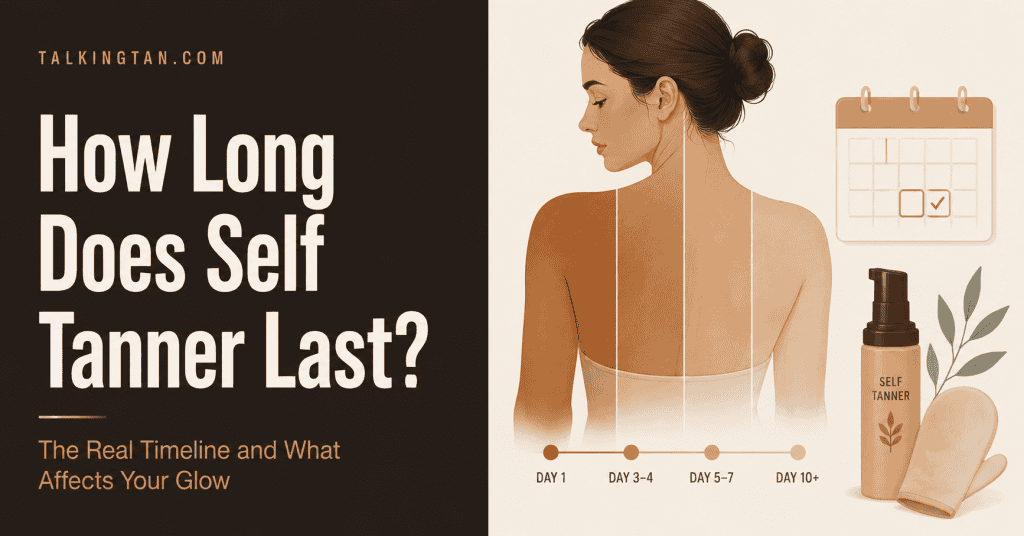
Most self tanners last 5 to 7 days before they start looking patchy, with a realistic range of 3 to 10 days depending on the product format, how well you prepped your skin, and what you do afterward. A mousse or lotion on well-exfoliated, moisturized skin will comfortably hold a week; tanning water, wipes, or a tan applied over dry, unprepped skin can start breaking up by day three.
Here is the part almost nobody explains properly: your tan lasts exactly as long as the skin it’s sitting on. It isn’t soaking into you, it isn’t in your bloodstream, and no amount of “locking it in” changes the biology. Once you understand that, the whole fade timeline suddenly makes sense — and you can predict it instead of being surprised by it.
Key Takeaways
- Average self tanner lifespan is 5 to 7 days, with 4 to 5 days of genuinely good color.
- DHA colors dead cells in the outermost layer of skin, so the tan sheds as those cells shed.
- Mousses and lotions last longest; water, wipes, and gradual tanners fade fastest.
- Professional spray tans typically run 7 to 10 days because of higher DHA concentrations and better prep.
- Exfoliate and shave before you tan, never after — post-tan exfoliation strips color immediately.
- Daily moisturizer is the single biggest factor in how evenly a tan fades.
- Chlorine, hot tubs, long baths, saunas, and heavy sweating are the fastest tan killers.
- For an event, apply 1 to 2 days beforehand — not the night before, not a week out.
Why Self Tanner Fades: The Part That Explains Everything
Nearly every sunless tanner on the market gets its color from dihydroxyacetone, or DHA. __DHA is a simple 3-carbon sugar that the FDA permits as a color additive in sunless tanning products for external use only__ [Braunberger et al., Journal of Drugs in Dermatology, 2018]. It reacts with amino acids on the surface of your skin to create brown pigments — the same family of browning reaction that turns toast golden.
The critical detail is where that reaction happens: the stratum corneum, the very outer layer of your skin, which is made entirely of dead, flattened cells on their way out the door. Your body sheds and replaces that layer continuously, roughly every two to four weeks, with the loosest surface cells coming off far sooner than that.
So your tan doesn’t “wear off” like paint. It falls off you, one microscopic flake at a time — in the shower, on your sheets, inside your clothes.
That’s also why the tan sits on top of your existing skin tone rather than replacing it, and why it offers no sun protection at all. __Reviews of topical DHA find it has minimal to no meaningful photoprotective effect__ [Owji et al., Photodermatology Photoimmunology & Photomedicine, 2023]. You still need sunscreen. If you want the full ingredient breakdown, we cover it in our guide to DHA in skincare and tanning.
How Long Self Tanner Lasts by Product Type
“Self tanner” covers formats that behave very differently. Here’s what to realistically expect from each.
Mousse — 5 to 8 days
The workhorse. Mousses carry a high DHA load, have a guide colour so you can see where you’ve applied, and dry fast enough to avoid transfer. This is the format to choose if longevity is your priority.
Lotion and cream — 5 to 7 days
Slightly shorter than mousse in practice, but the built-in moisture helps it fade more evenly, which often looks better on day six than a patchier mousse does. Great for dry skin types.
Tanning drops (mixed into moisturizer) — 3 to 5 days
You control the depth, but you’re diluting DHA into a carrier, so the colour is lighter and shifts off faster. Excellent for the face, where you’re re-applying every few days anyway.
Tanning water — 3 to 5 days
Lightweight, no transfer, beautifully natural — and the shortest-lived of the “real” tanners. Thin formulas deposit less DHA. Treat tanning water as a two-to-three-application-per-week habit rather than a one-and-done.
Tanning wipes — 2 to 4 days
Convenient, travel-friendly, and the least durable option because the amount of product a wipe can hold is capped. Good for a quick top-up on legs, not for a week of colour. Our guide to using tanning wipes covers getting the most out of them.
Gradual tanner / daily glow lotion — 2 to 3 days, but designed for daily use
These contain low DHA on purpose. Stop using them and the colour is essentially gone within 72 hours. They’re not really a “how long does it last” product — they’re a maintenance product.
Professional spray tan — 7 to 10 days
Salon solutions typically use higher DHA concentrations than retail products, applied evenly by someone who isn’t contorting to reach their own back. Prep is usually better too. That’s the whole reason spray tans outlast home tans. See how often you can spray tan for a sustainable schedule.
The Day-by-Day Fade Timeline
- Hours 0–8: Development. Colour is still building; the guide colour you see is not your final result. Don’t panic and don’t shower early.
- Day 1: First rinse. Guide colour washes away and you see the real tan. Slightly lighter than it looked — this is normal.
- Day 2: Peak. This is your best day. Colour is fully developed, even, and rich.
- Day 3: Still excellent. Most people can’t tell any difference from day 2.
- Day 4: First subtle softening, usually on hands, wrists, and around the face.
- Day 5: Noticeable lightening. Elbows and knees start looking dry or speckled.
- Days 6–7: Patchy phase. Fading is now uneven rather than uniform. This is the reapply-or-remove decision point.
- Days 8–10: Remnants only — usually clinging to ankles, knuckles, and knees. Exfoliate it off rather than tanning over it.
What Makes a Self Tan Last Longer
Exfoliate and shave BEFORE, never after
This is the rule that matters most. Exfoliating removes the loose dead cells that were going to shed in the next 48 hours anyway — so you’re applying DHA to fresher cells with more days left in them. Do it 12 to 24 hours ahead so your skin isn’t raw. Our pre-tan exfoliation walkthrough covers technique and timing.
Shaving is a form of exfoliation. Shave before, and your tan starts on a clean slate. Shave after, and the razor takes a stripe of colour with it.
Moisturize every single day
Dry skin flakes, and flaking skin is your tan leaving. A plain, oil-free body lotion morning and night is the highest-return habit in sunless tanning. Skip anything with AHAs, BHAs, retinol, or vitamin C on tanned skin — those actively accelerate cell turnover.
Shower cooler and shorter
Hot water softens the outer skin layer and speeds up shedding. Warm, quick showers beat long hot ones every time. And pat dry with a towel instead of rubbing — rubbing is exfoliation you didn’t intend to do.
Start on genuinely dry skin
Apply to skin that’s completely dry, with barrier balm only on the dry spots (knuckles, elbows, knees, ankles, heels). Damp skin makes DHA migrate and streak. More detail in our at-home self tanning guide and self tan tips and tricks.
Let it dry fully before dressing
Getting into clothes too soon lifts product off before it has reacted. Most formulas need 10 to 20 minutes touch-dry time — see how long self tanner takes to dry for format-specific timing.
What Kills a Tan Early
- Chlorinated pools — chlorine is a bleaching agent and it works fast. A long pool session can visibly lighten a tan in one afternoon.
- Hot tubs — heat plus chlorine plus soaking. The single worst combination.
- Long baths — soaking waterlogs the outer skin layer and loosens cells. Showers over baths, always.
- Saunas and steam rooms — heat and sweat together lift colour and often lift it unevenly.
- Heavy sweating — hot yoga, intense cardio, and sleeping hot all pull colour, especially in the first 24 hours.
- Harsh body wash — sulfates and “deep clean” scrubs strip colour every shower.
- Exfoliating scrubs, loofahs, and acid body lotions — the fastest way to end a tan on purpose.
- Old product — DHA degrades over time and expired tanner develops weak and fades early. Check our guide on whether self tanner expires.
Why It Fades Unevenly on Hands, Feet, Face, and Knees
Fading isn’t uniform because your skin isn’t uniform. Knees, elbows, ankles, knuckles, and heels have a much thicker outer layer with more dead cells packed in, so they absorb more DHA, go darker, and hang onto that darkness as everything around them lightens. That’s the classic “dirty knees” look on day six.
Hands and feet fade in the opposite direction: you wash your hands constantly, so colour there disappears first while it lingers in the knuckle creases. Your face fades fastest of all — facial skin turns over more quickly, and you’re cleansing, wearing makeup, and often using actives on it daily. Plan to re-tan your face roughly every 3 to 4 days even when your body still looks great.
The fix on all of these is the same: buff those spots with a barrier balm before applying, use the leftover product on your mitt rather than fresh product, and blend past the joint rather than stopping at it.
Can You Extend a Tan by Layering?
Yes, within limits. Layering a light second coat on days 2 to 3 — while the base is still even — refreshes colour and buys you another 3 to 4 days. This works because you’re topping up before the underlying layer has started shedding unevenly.
Layering on day 6 over a patchy tan does not work. You’re depositing new colour on top of an uneven base, which locks the patchiness in and makes it darker. Once fading turns blotchy, remove and restart. See how to make self tanner last longer for the full maintenance routine, and whether you can layer spray tans if you go the salon route.
When Should You Apply Before an Event?
Apply 1 to 2 days before. Day 2 is your peak — that’s the day you want to land on.
- Wedding, prom, photos: apply 2 days ahead. This gives you a buffer to fix anything and lets the tan settle into its natural finish.
- Casual night out: 1 day ahead is fine.
- Vacation: apply 2 days before you fly so it’s set before pool and sea exposure — more in our spray tan before vacation guide.
- Never the same day unless you’re using an instant wash-off bronzer. Real DHA colour needs 6 to 8 hours minimum, and rushing it is the top cause of streaks. If you’re short on time, see how to make fake tan develop faster.
Frequently Asked Questions
How long does self tanner last on your face?
About 3 to 4 days — noticeably shorter than on the body. Facial skin turns over faster and you cleanse it daily, so plan on a lighter top-up mid-week.
Does self tanner get darker the longer you leave it on?
Up to a point. Colour keeps deepening for roughly 6 to 8 hours, then plateaus. Leaving it on for 12 hours instead of 8 adds very little and increases the streak risk. Sleeping in self tanner is fine with overnight formulas but not necessary for depth.
How often should I reapply self tanner?
Every 4 to 7 days for most people. Once the fade turns patchy rather than uniform, exfoliate everything off and start clean instead of layering over it.
Does swimming remove self tanner?
Chlorinated pools fade it fastest; saltwater is gentler but still speeds things up. Rinse immediately after swimming and moisturize while your skin is still damp.
Why did my self tanner only last two days?
Almost always dry or unexfoliated skin at application, a very lightweight formula like water or wipes, a shower too soon after applying, or expired product.
Does self tanner last longer on dark or light skin?
The lifespan is the same, because it’s driven by your skin cell turnover, not your base tone. It just becomes visually noticeable sooner on lighter skin, where the contrast between tanned and untanned areas is greater.
The Bottom Line
Plan around 5 to 7 days, expect days 2 and 3 to be your best, and stop thinking of fading as a product failure. It’s your skin doing exactly what it’s supposed to do. Since DHA only colours the cells on the very surface, everything that extends a tan comes down to one idea: don’t remove those cells faster than you have to.
Exfoliate and shave before, moisturize daily, keep showers warm rather than hot, pat dry, and stay out of hot tubs. Do those five things and you’ll get a genuinely good week out of a tan that would otherwise fizzle by Thursday. And remember that a sunless tan gives you zero UV protection — sunscreen is still non-negotiable.
References
Dihydroxyacetone (DHA) and sunless tanning:
Braunberger TL, Nahhas AF, Katz LM, Sadrieh N, Lim HW, 2018, Journal of Drugs in Dermatology, “Dihydroxyacetone: A Review” Confirms DHA is a 3-carbon sugar permitted by the FDA as a color additive for external application, and that sunless tanners are regulated as cosmetics, not sunscreens.
DHA safety and photoprotection:
Owji S, Teklehaimanot F, Maghfour J, Lim HW, 2023, Photodermatology, Photoimmunology & Photomedicine, “Properties and safety of topical dihydroxyacetone in sunless tanning products: A review” Found DHA has minimal to no observable photoprotective properties, and that ingestion, inhalation, and mucosal contact should be avoided.