
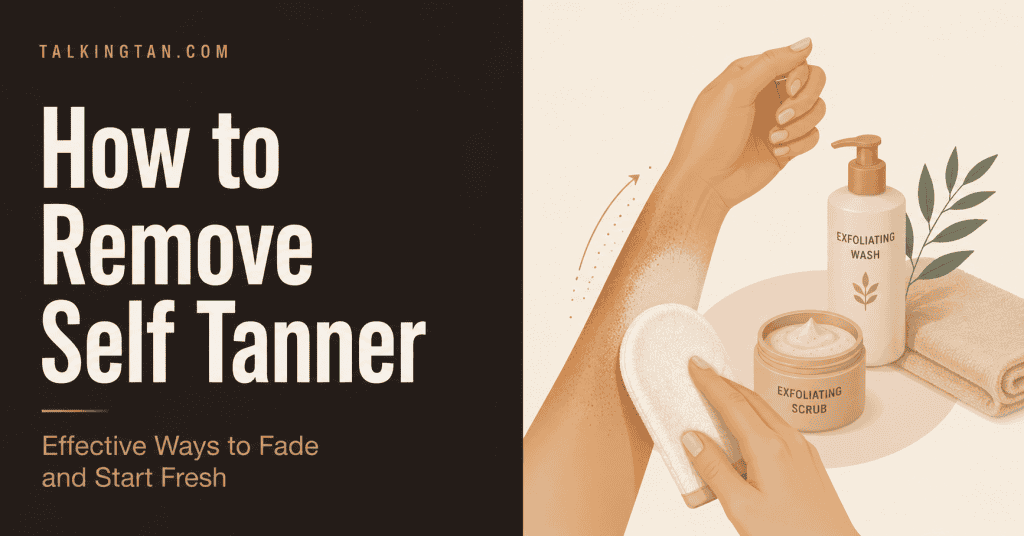
To remove self tanner, you have to exfoliate — not wash. Soak the skin in oil or a hot bath for 10–20 minutes to loosen the tanned surface cells, then buff with an exfoliating mitt, a baking soda paste, or a dedicated tan remover. Rinse, repeat once if needed, and moisturize afterward.
That’s the whole game. Soap and water barely touch a developed self tan because the color isn’t sitting on your skin — it’s chemically bonded inside the very top layer of it. Here’s how to strip a streaky, patchy, or way-too-orange fake tan without wrecking your skin in the process.
Key Takeaways
- Self tanner color comes from DHA reacting with proteins in your dead surface skin cells — removal means exfoliating those cells off, not washing them clean.
- The most reliable combo is oil soak → exfoliating mitt → rinse → moisturize. Nearly everything else is a variation on it.
- Dedicated tan removers (glycolic or lactic acid based) are the most effective off-the-shelf option; baking soda paste and a hot bath cost almost nothing and work well.
- Undiluted lemon juice and aggressive scrubbing are the fastest routes to raw skin. Go easier than you think you need to.
- For orange hands, feet, ankles, and knees, spot-treat — don’t strip your whole body to fix four small areas.
- A fresh tan mostly comes off in one session; a fully developed 3-day-old tan may need two rounds.
Why Self Tanner Is So Hard to Wash Off
Almost every self tanner, mousse, drop, wipe, and spray tan solution uses the same active ingredient. DHA (dihydroxyacetone) is a simple three-carbon sugar that the FDA permits as a color additive in sunless tanning products [Owji et al., Photodermatology, Photoimmunology & Photomedicine, 2023]. On skin, it reacts with amino acids in the stratum corneum — the outermost layer, made of dead, flattened cells on their way out — producing brown pigments called melanoidins.
Two things follow from that.
First, the color is in the cells, not on them — there’s nothing sitting on the surface for soap to lift off. Second, the tan fades only as fast as those cells shed, roughly 5 to 10 days. Removing it early means accelerating that shedding.
That’s also why washing off a spray tan too early gives you a weaker result rather than none at all. For the full chemistry in plain English, see our guide to DHA in skin care and tanning. Worth noting too: DHA tans offer minimal to no sun protection, so fake tan never substitutes for SPF [Owji et al., Photodermatology, Photoimmunology & Photomedicine, 2023].
The Removal Methods, Ranked
1. Oil Soak, Then Exfoliate (Best All-Rounder)
Slather on a generous layer of coconut, olive, baby, or body oil and let it sit 10–20 minutes — longer is better. Oil softens the outer layer and loosens the bonds between tanned cells, so far less friction is needed to lift them.
Then get in a warm shower and work over the skin with an exfoliating mitt in firm circles. Rinse, check progress, repeat once if needed. The oil does most of the work, which means less scrubbing and less irritation — making this the safest option for sensitive skin and large areas.
2. A Dedicated Tan Remover (Most Effective Product)
Purpose-built tan removers come as mousses, gels, and pads, and most use glycolic or lactic acid — mild AHAs that dissolve the “glue” holding dead cells together. Apply, wait 5–10 minutes, rinse, lightly buff.
They’re the best performer on a stubborn, developed tan and kinder than sandpapering yourself with a scrub. Follow the bottle’s timing exactly — leaving an acid on longer doesn’t remove more tan, it just irritates you. Skip them on freshly shaved, waxed, broken, or sunburned skin.
3. Baking Soda Paste (Best Budget Fix)
Mix baking soda with a little water into a thick paste, apply to damp skin, massage in gentle circles for a minute or two, rinse. It’s a fine physical exfoliant plus a mild alkaline nudge, and it works surprisingly well on patchy areas. Don’t leave it on for long, don’t use it on your face, and don’t repeat more than once a day — it’s alkaline and can leave skin tight and stripped.
4. Exfoliating Mitt or Body Scrub Alone
A mitt on its own absolutely removes fake tan — exfoliating is the core mechanism behind every method here. It’s just slower without an oil or acid softening things first. Use it on damp skin, in circles, and stop the second skin goes pink. A sugar or salt scrub does the same job more gently.
5. Hot Bath and Soak
A 20-minute soak in a hot (not scalding) bath softens the stratum corneum beautifully — add a cup of baking soda or a few tablespoons of oil to boost it. Exfoliate in the bath, while skin is at its most pliable. This is the classic night-before-the-event reset, and it’s very effective on a tan that’s only a day or two old.
6. Whitening Toothpaste (Small Spots Only)
The mild abrasives and peroxide in whitening toothpaste can lift a dark spot on a knuckle, cuticle, or nail bed. Dab it on, leave it 5 minutes, buff with a toothbrush or cloth, rinse. This is a pinpoint tool, not a body treatment — never use it on your face or large areas.
7. Lemon Juice (Diluted, With Caution)
Diluted 50/50 with water, the citric acid in lemon juice can fade a light tan on hands. Used neat it’s genuinely risky: it’s highly acidic, and lemon on sun-exposed skin can cause phytophotodermatitis — a blistering burn reaction. Dilute it, keep it to small areas, rinse thoroughly, stay out of the sun. Or just use a proper tan remover.
8. Swimming Pool Chlorine (Works, But It’s a Side Effect)
Chlorine strips fake tan — it’s why spray tans fade fast in a pool. A 30–45 minute swim noticeably lightens a tan.
It’s unpredictable, can go patchy, and chlorine is drying. Treat it as a helpful accelerant if you’re swimming anyway, not as a plan.
What Actually Works vs. Internet Myths
- Works: oil soaking, AHA tan removers, physical exfoliation, hot water, baking soda, chlorine, and time.
- Barely works: body wash, micellar water, cold showers, scrubbing dry skin.
- Overrated: vinegar, toothpaste over large areas, “tan removing” wipes that are just cleansing wipes.
- Risky: undiluted lemon juice, at-home peels, bleach in any form, peroxide over big areas, and scrubbing hard enough to hurt.
A note on magic erasers: they do remove fake tan, because melamine foam is an extremely fine abrasive — essentially very fine sandpaper. Which means it’s easy to take off more than tan. We’ve covered using a magic eraser to remove a spray tan in detail; the short version is keep it wet, keep it to hands and feet, and use almost no pressure.
Fixing Just Your Hands, Feet, Ankles and Knees
This is the most common self tan problem. Hands, feet, elbows, knees, and ankles have thicker, drier skin that grabs far more DHA, so they go dark and orange while the rest of you looks fine. You don’t need to strip your whole body — spot-treat:
- Soak the area in warm water for 5–10 minutes — a bowl for hands, a basin for feet.
- Apply oil or a tan remover to only the dark patch; a cotton pad gives precision at the wrist and ankle line.
- Buff with a mitt or soft toothbrush, working outward and feathering the edges so you don’t create a hard line.
- Rinse, assess, repeat — rather than going harder in one pass. Then moisturize.
Feathering is the step people skip, and it’s the difference between “fixed” and “obvious pale ring around my ankle.” Our guide to getting spray tan off your hands and feet goes deeper, and if the problem is uneven lines rather than darkness, fixing spray tan streaks may be the better move — sometimes blending beats removing.
Emergency Removal Before an Event
A few hours, a tan that looks wrong. Fastest safe sequence:
- Oil, immediately. Coat the affected skin thickly and let it sit 20 minutes.
- Hot bath or steamy shower, 15 minutes. Heat and humidity soften everything.
- Exfoliate in the water with a mitt, in sections, 60–90 seconds per area.
- Rinse and assess dry, in good light. Wet skin looks darker than it is.
- One more round if needed, after a 15-minute break. Back-to-back scrubbing is where skin gets damaged.
- Moisturize, then even out what’s left. Gradual tanning lotion or body makeup over the lightened areas often beats another removal round.
If the tan is under 4 hours old and hasn’t fully developed, act now — a fresh tan comes off far more easily. The full guide to getting a spray tan off has more options for salon tans.
How to Remove Tan Without Damaging Your Skin
Exfoliation done badly leaves you red, raw, and worse off than a bad tan.
- Never exfoliate dry skin. Water and oil are non-negotiable lubricants.
- Circles, not sawing. Back-and-forth friction concentrates damage in one line.
- Stop at pink. Redness means you’ve reached living skin. Anything past that is injury, not removal.
- Don’t stack methods. An acid remover and a baking soda scrub and a magic eraser in one session is too much.
- Skip removal on compromised skin — sunburn, eczema flares, cuts, freshly waxed or shaved areas, active breakouts.
- Be gentler on your face. No baking soda, toothpaste, or mitts — use a mild chemical exfoliant or cleansing balm and accept slower progress.
- Watch for reactions. Irritant and allergic contact dermatitis from DHA products has been documented, so if skin is itching, burning, or breaking out, treat it as a reaction rather than scrubbing harder [Owji et al., Photodermatology, Photoimmunology & Photomedicine, 2023].
What to Do After You’ve Removed It
You’ve just taken off part of your skin’s protective barrier — treat it accordingly.
- Moisturize generously for 48 hours — fragrance-free cream or rich body butter, twice a day.
- Wear SPF. Freshly exfoliated skin is more sun-sensitive, and the fake tan you removed was never protecting you anyway.
- Wait 24 hours before reapplying tan. Tanner over freshly stripped skin develops fast, dark, and blotchy.
- Skip retinoids, acids and hot tubs for a day or two.
- Prep properly next time. Most removal jobs are prevented at the application stage — see our home self tanning guide and self tan tips and tricks.
Frequently Asked Questions
How do you remove self tanner fast?
Apply oil generously, wait 15–20 minutes, then exfoliate with a mitt in a hot shower. That’s the fastest home method. A dedicated glycolic or lactic acid tan remover is faster still if you have one on hand.
Does soap and water remove self tanner?
No. Once DHA has reacted with the top layer of skin, the color is inside those cells. Soap removes undeveloped tanner and cosmetic bronzer in the first few hours, but not a developed tan.
How long does self tanner take to fade on its own?
Usually 5 to 10 days, depending on product strength, your skin’s turnover rate, and how often you shower, swim, or exfoliate.
Will baking soda remove fake tan?
Yes — as a paste with water, massaged gently onto damp skin. Keep contact time short and avoid your face and irritated skin.
How do I remove self tanner from my face?
Gently. Use an oil cleanser or cleansing balm, follow with a mild AHA or a soft konjac sponge, and be patient over two or three days rather than scrubbing once.
Does removing self tanner also remove a real sun tan?
No — a real tan is melanin produced in living skin cells, so exfoliation only fades it slightly and gradually. If that’s what you’re dealing with, see our guide on how to get rid of a tan.
Can I reapply self tanner right after removing it?
Wait at least 24 hours. Freshly exfoliated skin absorbs DHA unevenly and much more intensely, which usually recreates the exact problem you just fixed.
The Bottom Line
Removing self tanner isn’t about finding a magic product — it’s about accepting that the color lives inside your dead surface skin cells and has to come off with them. Soften first with oil, heat, or a mild acid; exfoliate patiently; moisturize. Two gentle sessions beat one aggressive one every time.
If the damage is limited to hands, feet, or ankles, spot-treat and feather the edges instead of stripping everything. If you’ve got hours until an event, oil plus a hot bath plus a mitt is your fastest safe route. And next time, five minutes of prep — exfoliating the day before, moisturizing dry spots, applying with a mitt — prevents nearly every removal emergency in this article.
References
DHA and Sunless Tanning:
Owji S, Teklehaimanot F, Maghfour J, Lim HW, 2023, Photodermatology, Photoimmunology & Photomedicine, “Properties and safety of topical dihydroxyacetone in sunless tanning products: A review” Found DHA provides minimal to no photoprotection, and that irritant and allergic contact dermatitis from DHA exposure has been reported.
DHA Regulation and Use:
Braunberger TL, Nahhas AF, Katz LM, Sadrieh N, Lim HW, 2018, Journal of Drugs in Dermatology, “Dihydroxyacetone: A Review” Confirms DHA is a three-carbon sugar permitted by the FDA as a color additive in sunless tanning products, for external use only.